 REINFORM
Follow one side seam through the complete tee
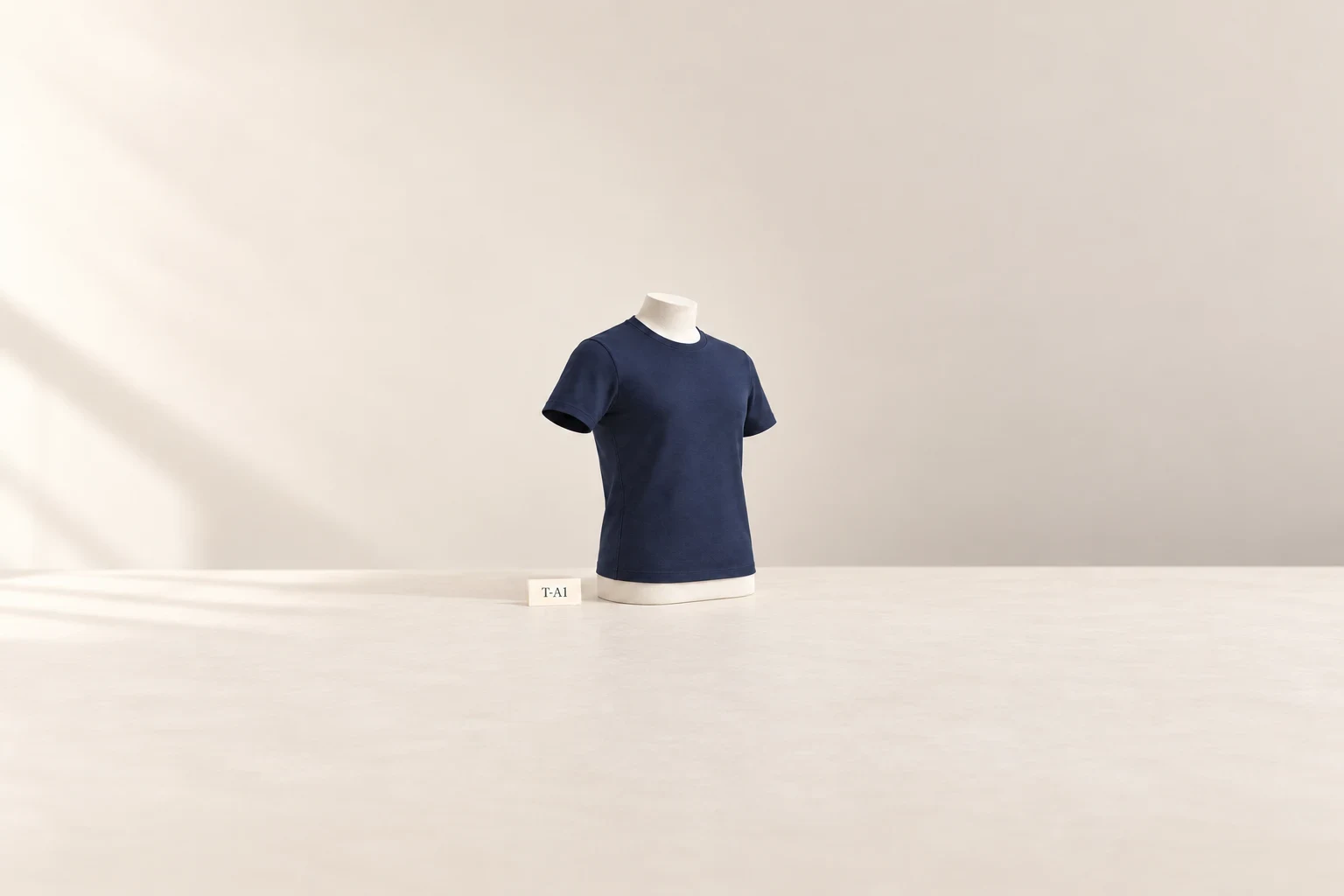
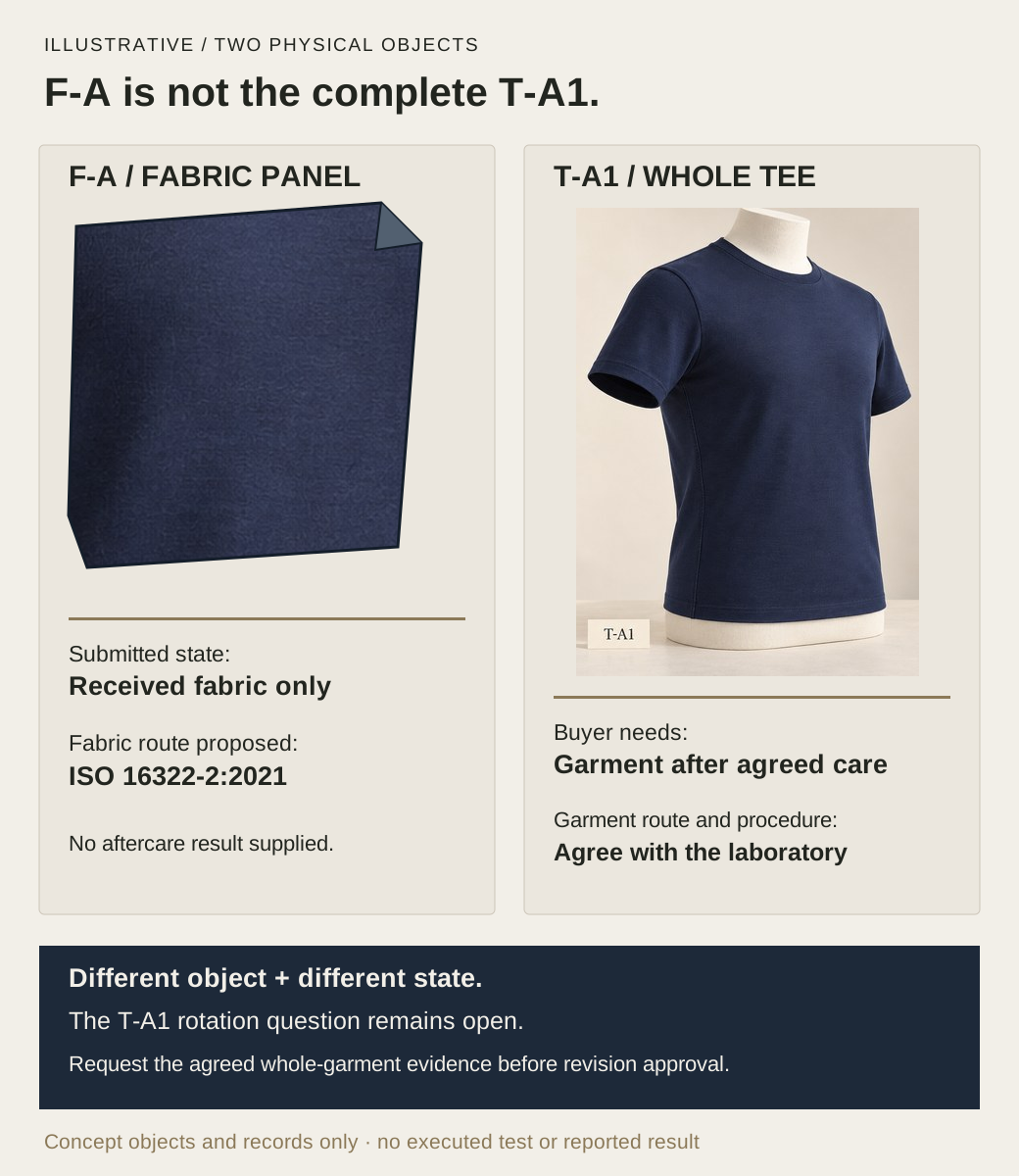
Start with the garment’s geometry. T-A1 has a plain crew neck, two short sleeves and a continuous torso finished with a stitched hem. Its right underarm is the upper landmark for the seam discussed here. The point where that seam reaches the hem is the lower landmark. Keeping the whole torso visible explains why a seam that moves towards the front matters; a tight photograph of the hem can conceal how far around the body it has travelled.
First check that the reference drawing actually intends a conventional side seam. Some garments deliberately place seams away from the side, so an angled line is not automatically a defect. The buyer needs the intended panel arrangement before judging a sample. For T-A1, the hypothetical brief calls for the same side-seam arrangement across the received and care-reviewed garment. The illustration exaggerates the route enough to explain the question, without assigning an amount.
Separate three observations. A change in body length or width is a dimensional issue. Local gathers or waves along a join are an appearance issue. A seam that changes its position around the torso is a geometric rotation issue. They can coexist, but one photograph or result should not stand in for all three. Describe which line moves and which landmarks remain identifiable, rather than asking the supplier to make the shirt generally look straighter.
Keep local joining waves in the separate seam-puckering review.
Keep the received reference without making it a test result
For an actual project, retain an overview of the identified garment as received and a closer view of the questioned seam. Identify the wearer’s right side consistently. A photograph described only as the left image can become ambiguous when a colleague turns the garment over or mirrors a picture. The underarm, seam at the hem and a recognisable front view make the concern easier to relocate.
The reference should show what arrived. Do not quietly press, pull or rotate the shirt into a more symmetrical presentation before keeping that record. If handling has already changed its appearance, record that history. A form is helpful for explaining the illustrated geometry, but the form’s posture and tension can also affect presentation. The images here therefore carry no measurements and do not establish a laboratory preparation method.
A received-state photograph is supporting buyer documentation. It is not an ISO 16322-3 measurement of the garment as manufactured. That distinction matters when a supplier places an initial photograph beside an aftercare result: the two may help explain the concern, while only the correctly commissioned procedure can establish what its reported result means. Keep the observation, the test evidence and the buyer’s acceptance requirement separate.
Choose a spirality test for the garment question
ISO 16322-3:2021 has a public scope for spirality or torque of woven and knitted garments after domestic laundering. Its abstract excludes measuring the garment’s as-manufactured spirality and cautions that results from different procedures may not be comparable. For T-A1, the practical consequence is to ask the laboratory which applicable garment procedure and edition will address the agreed post-care question.
ISO 16322-2:2021 concerns woven and knitted fabrics after laundering. Its public abstract names several procedures, including mock-garment marking. A specimen described as a mock garment under a fabric procedure should not silently become evidence that the actual T-A1 assembly meets the buyer’s garment requirement. Check what was physically submitted and evaluated, rather than relying on the word garment appearing somewhere on the paperwork.
Agree the relevant procedure, care route and acceptance requirement with a competent laboratory before relying on a result. Public summaries do not provide the complete instructions, apparatus details or a universal pass threshold. This guide supplies none of those missing details. If a buyer already has an agreed specification, use its current controlled requirement; if not, resolve that gap instead of taking a percentage or wash programme from an unrelated online example.
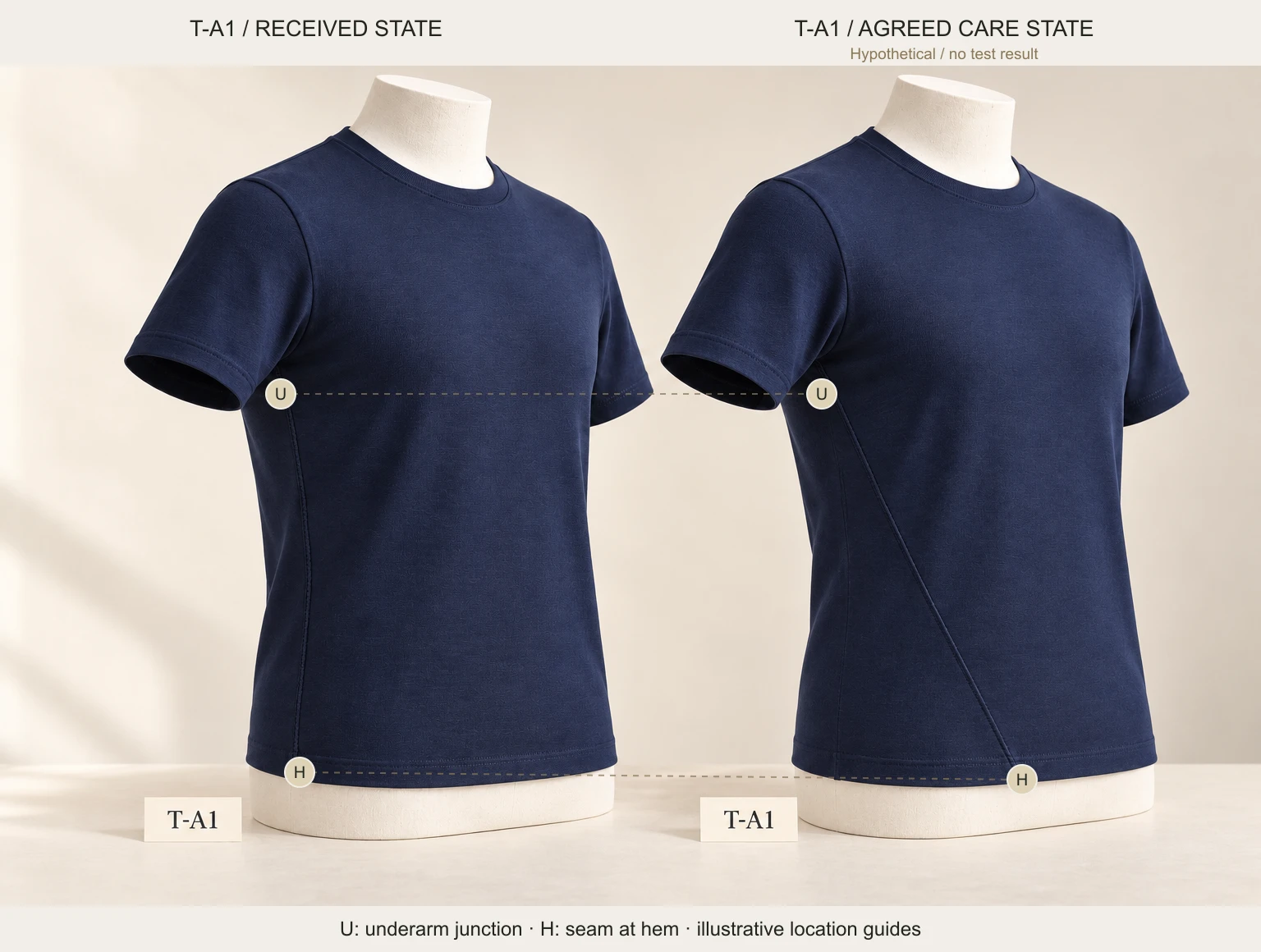
F-A fabric does not answer T-A1’s torso question
Consider a specific hypothetical mismatch. The supplier submits a flat navy fabric panel identified as F-A, together with a received-state material record and a proposed fabric-test route. The buyer asked about the complete T-A1 tee after the agreed care treatment. F-A may be relevant to material selection, but neither its physical form nor the state supplied answers whether T-A1’s seam moves around the torso after care.
The difference is tangible. F-A has no T-A1 underarm junction, sleeve attachment or sewn torso ending at the hem. Even a completed fabric report with matching material identification would answer its stated fabric question. It would not automatically answer every effect of assembling that material into this garment. Request the missing whole-garment evidence without declaring the fabric unsuitable simply because the wrong evidence was supplied.
This is also a real commissioning distinction. Centrocot’s July 2025 laboratory catalogue separately lists fabric spirality under ISO 16322-2 and garment spirality under ISO 16322-3. Those particular catalogue entries carry its non-accredited-item marker. The useful point here is the different objects and commissions, not an accreditation claim, an endorsement of a provider or evidence that REINFORM has conducted either test.
Compare the same landmarks in the agreed care state
Return to T-A1 once appropriate evidence is available. Follow the same right underarm junction and the same side seam down to its meeting with the hem. In the explanatory pair, the lower seam lies farther towards the front in the hypothetical care-reviewed state. The smoothness of the stitching does not remove that change in position. Conversely, a local crease does not by itself establish that the entire seam has rotated.
Use matched overview photographs to make the observation understandable, with the garment identity, orientation and care state made explicit. Keep a clear view of the front and both underarm regions. If the supplier photographs one garment flat and the other stretched around a different form, ask how those presentations relate to the comparison. Photographic alignment is documentation; it is not a substitute for the laboratory’s specified preparation and measurement.
Read any reported amount only with its actual method, procedure and specimen context. Do not calculate a percentage from these illustrations or compare numbers that use different procedures as though they share a scale. If the report and photograph appear inconsistent, ask the laboratory to clarify the measured object and location. An attractive photograph should not overrule a relevant result, and an unexplained number should not overrule an unresolved identity mismatch.
Keep the separate dimensional and appearance findings visible. A shirt might satisfy its agreed length and width requirement while the side-seam question remains open. If the supplier proposes a new material or finishing route, review its effect on the garment brief as well as the rotation concern. The buyer should not trade away fit or another agreed requirement merely to obtain a different seam presentation.
Make the next revision instruction specific to T-A1
The first decision in the F-A example is an evidence hold on the T-A1 revision. It is not a declaration that the fabric failed or that every garment is defective. Ask for an identified complete garment submission evaluated under the agreed garment scope and care route, with evidence that can be related to the right underarm-to-hem seam. Keep the material record for the question it actually addresses.
If the correct garment evidence then satisfies the agreed requirement, record acceptance for that named material and garment revision. If it does not, ask the supplier to propose a controlled change and explain what it is intended to address. Possible areas of investigation belong with the supplier’s technical team; an image alone cannot identify the yarn, knitting, finishing, cutting or assembly contribution. A proposed explanation remains a hypothesis until suitable evidence supports it.
Do not instruct the supplier to shift a pattern line merely to make the photographed seam appear centred. Such a change could alter the intended panel arrangement while leaving the underlying care behaviour unresolved. Ask what changed in the garment or material proposal, what stayed the same and which whole-garment review will close the original concern. Keep the earlier reference available when a replacement sample arrives.
When a revision B is proposed, link it back to that instruction. The next comparison should show the same seam and landmarks and identify any change to material, panels or processing. Approving a new photograph without knowing what was changed makes later repeat orders harder to control. Acceptance should close the actual geometric concern, rather than close a message thread because a new sample looks tidy.
Close the seam question without expanding the approval
The final record can be short because the physical question is precise: which T-A1 revision was reviewed, where its right seam runs from underarm to hem in the agreed state, what relevant evidence was accepted and which outstanding conditions remain. Attach the identified views and actual report reference. If the evidence was resubmitted unchanged, record that too, so a request for better documentation is not mistaken for a pattern correction.
Keep the result within its scope. Acceptance of this garment’s rotation requirement is not approval of every size, material substitution, production lot or shipment. A changed construction or care route may require a fresh review. Other development, inspection and delivery decisions still have their own owners. The benefit of this approach is a clear answer about the seam around one complete garment, with a traceable route to the next approved revision.
Use the wider fabric-testing guide to commission other material questions separately.
The ISO sources are public abstracts, not the full paid procedures. Part 3 addresses garment spirality after domestic laundering; Part 2 addresses fabric. Their scope and comparability cautions do not supply a test recipe, calculation or acceptance limit. Centrocot’s July 2025 catalogue demonstrates separate fabric and garment commissions; the cited entries carry its non-accredited-item marker. It does not establish a REINFORM laboratory relationship or test. T-A1, F-A and the illustrated states are hypothetical, with no measured results.
Bring the whole garment and the open seam question
Share the garment reference, material revision, intended care route and the seam location that needs review. Project-specific OEM/ODM sample arrangements and evidence requirements can then be discussed.
Discuss an OEM/ODM garment brief