 REINFORM
Start the seam puckering review with one identifiable join
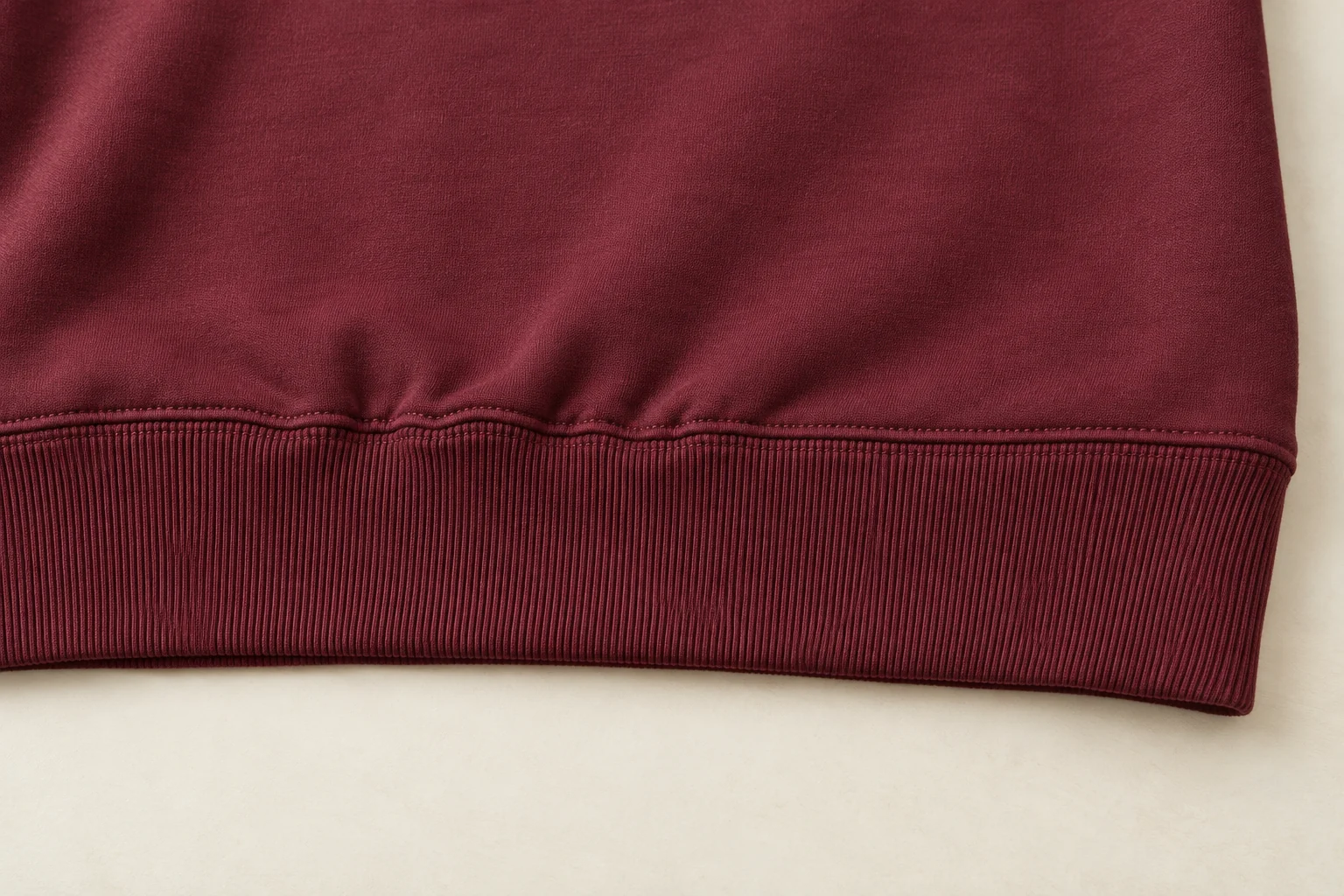
The example here is a proposed burgundy sweatshirt: smooth body knit above a matching rib hem, with local waves along their horizontal joining seam. The illustration is hypothetical, not a REINFORM trial or an approved colourway. Body, rib and thread references remain to be selected. The buyer’s task is to decide whether this assembly can be approved, needs another trial or should stay on hold. A photograph alone cannot answer that question.
Name the location precisely: lower front, body-to-rib join, with the garment’s left and right identified. Mark the affected region on an overview and keep an unmarked original photograph. Distinguish the local irregularity from the planned fullness where a body joins a narrower rib band. If the design brief does not explain the intended body-to-band relationship, resolve that ambiguity first. Otherwise a supplier may remove the intended shape while trying to satisfy a vague request for a flatter hem.
Identify the physical sample and its history. Was this the received garment, a newly sewn reference, a pressed presentation sample or a piece already put through care? Record what is known and leave missing history open. Preserve the questioned reference before anyone alters it. The supplier needs to examine the same concern that the buyer recorded, rather than a replacement hem that has already been handled differently.
Ask for a supplier hypothesis, not a diagnosis from a photograph
Coats’ industrial bulletin describes several interacting contributors, including material structure, thread and needle selection, sewing tension, feeding and dimensional behaviour. That supports a supplier investigation, not a conclusion that the burgundy join has one particular cause. Ask the technical team which explanation they propose, what observation supports it and what remains uncertain. Keep the observed wave separate from the suggested cause in the correspondence.
For this body-and-rib assembly, ask whether the proposed trial addresses component compatibility, how the two materials enter the join, the selected sewing system or another identified factor. The supplier should specify the relevant investigation and trial; the buyer should define the garment requirement. Do not prescribe a universal tension setting or needle size from an online example. Nor should the buyer turn a supplier’s diagnostic procedure into instructions for cutting apart a garment at home.
A useful reply distinguishes evidence from expectation: “We propose revising the documented joining operation while retaining the selected body and rib references; the trial will be reviewed against the retained sample.” That is a request to investigate, not proof of a cause or a promised improvement. If the supplier proposes changing the rib reference instead, ask why, identify that substitution explicitly and review the implications for appearance, dimensions and the quotation.
Commission a controlled trial that can be traced back to the hem
Keep a retained reference and give the proposed revision its own trial identity. Both must identify the body, rib, thread and construction revision, with the same seam location and orientation. A flat piece of main fabric without the rib join cannot answer the question. Ask the supplier whether an assembly trial is enough for the initial investigation and when the complete garment must be resampled. Final approval should address the garment context that matters to the order.
Define what changes and what stays fixed before the trial is made. Where feasible, a single defined change makes the comparison easier to interpret. If the supplier needs a combined revision, list the whole package and avoid attributing any difference to one element alone. A different body fabric, rib, sewing operation and finishing route is a new assembly proposal, even if the replacement carries the same style name. Keep that distinction visible in the revision record.
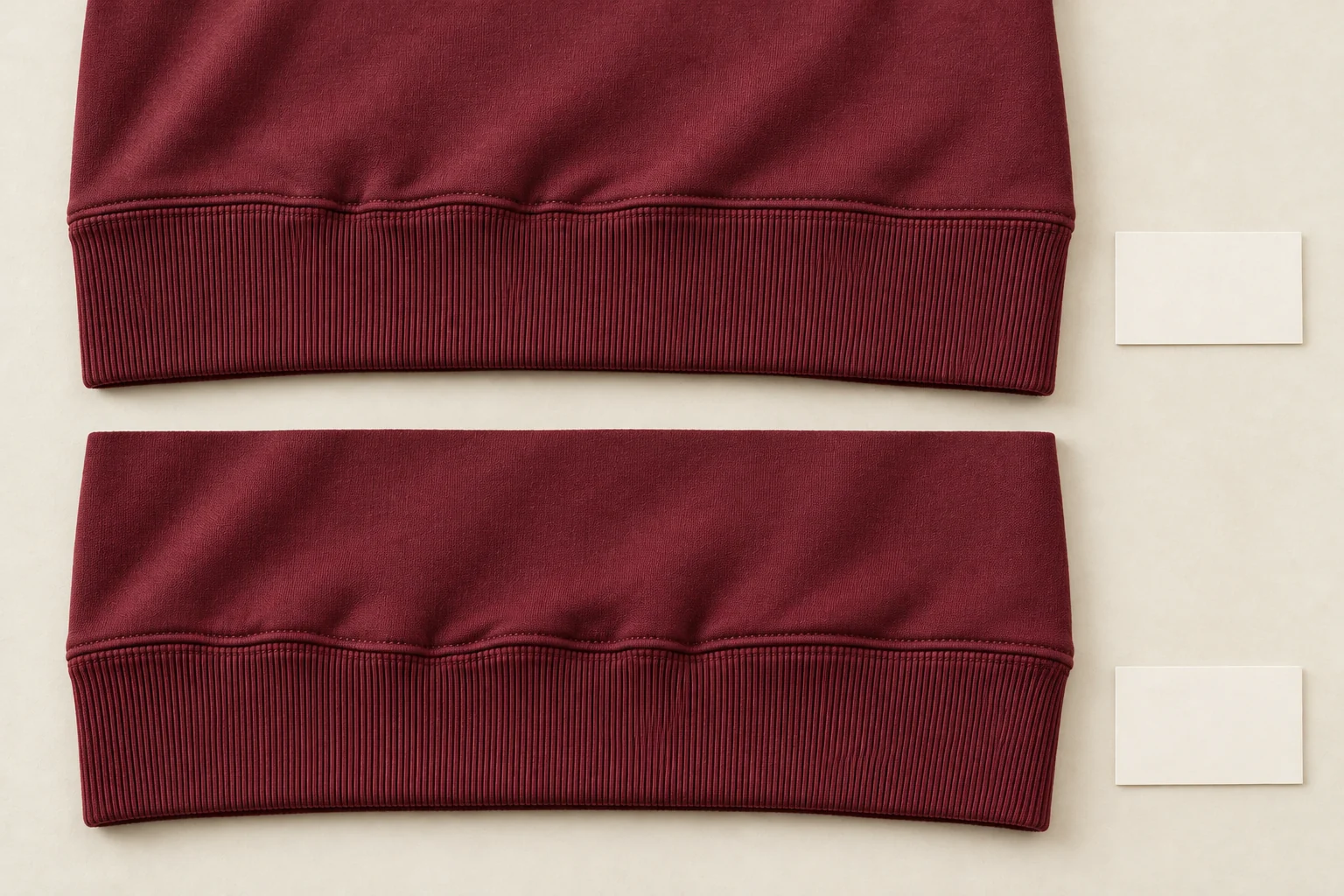
Agree who supplies the trial, which references accompany it and what the buyer will review. Request the supplier’s actual construction and process record at the level needed for traceability, rather than inventing settings in the purchase brief. Retain the original trial identifiers when photographs and comments are exchanged. Blank tags in the illustration show where identification belongs; they are not completed factory records or evidence of successful correction.
Compare received references under consistent conditions
Arrange the retained reference and trial in the same orientation, with the body above the rib, and compare the same portion of the join. Agree the viewing position, lighting, support and handling rather than letting one sample hang while the other is stretched flat. Include a context view of the hem and a close view of the questioned region. Avoid pulling the rib until the waves disappear for a photograph; that changes the state being presented.
AMANN notes that visible puckering can become apparent at different stages, including sewing, pressing or a subsequent rest period. Accordingly, a freshly finished trial should not be treated as equivalent to a reference with a different history. Ask the supplier to state finishing and handling, and agree when the appearance review will occur. A smoother photograph immediately after pressing does not establish that the physical cause has been identified or that the change will persist.
Describe what is visible without inventing a grade: where the wave begins and ends, which face is affected, whether the joining line turns or the band appears uneven, and what remains unresolved. If a buyer-approved appearance reference exists, identify its revision and state. If one does not exist, agree the review basis before calling the trial acceptable. Keep seam waviness, rib texture, loose handling folds and intentional gathering as separate observations.
Review the agreed care state separately
Do not close the issue solely from the received-state comparison if the approval brief also requires appearance after care. Define the intended evaluation route with the supplier or laboratory, including the applicable material or garment scope, treatment, drying, preparation and review conditions. Record the selected route rather than choosing a generic wash temperature or cycle count from this article. Retain an identifiable baseline so later observations can be related to the original assembly.
The public summary of AATCC TM88B-2018te concerns seam smoothness in washable fabrics after home laundering, including woven, knitted and nonwoven fabrics. It does not prescribe how to sew the seam. Only the public summary was reviewed for this guide. If it is specified for a project, confirm the applicable edition, complete procedure, specimen suitability and reporting with the laboratory; agree the acceptance requirement separately. This article supplies neither its grading materials nor a universal passing grade.
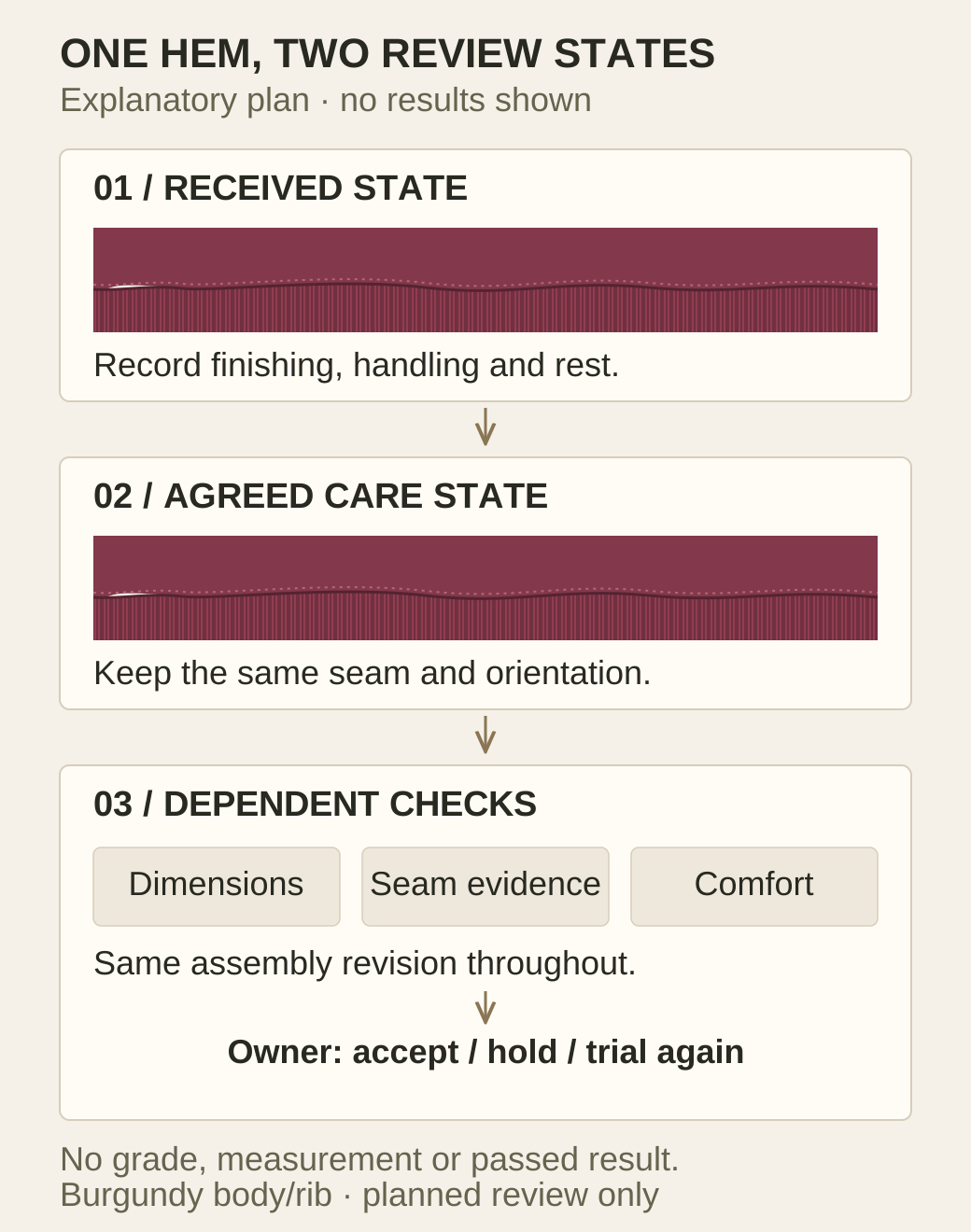
Compare received reference with received trial, and their agreed post-care states with each other. The change within one trial across care is useful information, but it is a different comparison. If the burgundy body and rib no longer present an acceptable join after the agreed treatment, keep that finding attached to the trial revision. Do not rename it a new unrelated defect or approve the earlier presentation photograph instead.
Reopen the requirements affected by the correction
Appearance approval covers appearance. A changed thread, construction or joining operation can also reopen requirements that were agreed elsewhere in the specification. Ask the technical team which checks need repeating for the revised assembly. A smoother-looking hem is not evidence of seam strength, extension or resistance to opening. Where laboratory work is required, confirm a suitable method and specimen with the laboratory rather than automatically applying a woven-seam method to this knitted join.
Keep force and failure questions in the separate seam-strength brief.
Carry dimensions back to the complete sweatshirt. Check the agreed body length, hem sweep and band relationship using the named measurement points and sample state. A revised band or join should not silently change the intended silhouette or available room over the wearer’s chosen layer. Record the relevant dimensional observations before and after the agreed care route. A length or width result alone does not resolve the visible local wave, and a visually calmer seam does not confirm the finished measurements.
Review the inside finish and garment contact where the revised hem sits. Identify any new bulk, stiffness or uncomfortable edge and examine dressing and normal movement with the intended layer. If support or decoration backing was changed, inspect its actual position rather than accepting a detached component. These are garment-review questions, not substitutes for a specified laboratory result. Keep every reopened requirement linked to the same trial so a visual decision cannot accidentally release an unresolved functional change.
Use a seam-appearance correction record
The following fields form a buyer’s working record, not a prescribed test report. Use one record for this body-to-rib hem concern and link supporting files to it. The record should let someone outside the email exchange identify the questioned assembly, understand the proposed revision and see why an approval remains open.
- Assembly and baseline: style/sample identity, revision, burgundy body and rib reference codes, thread reference, lower-front seam location, garment direction and retained physical reference.
- Observed state: received, finished, rested or treated status; known handling history; dated overview and close photographs; exact region of local waviness and any missing information.
- Requirement: intended body-to-band relationship, named appearance reference or agreed review basis, required care state and decision that this review is meant to support.
- Supplier hypothesis: proposed explanation, supporting observations, uncertainty and responsible technical contact. Keep this field separate from the buyer’s visible observation.
- Trial revision: actual changes, unchanged controls, component substitutions, construction/process record references and whether the submitted piece is an assembly trial or complete garment.
- Comparison: matched orientation and viewing conditions, received-to-received and care-to-care observations, residual issue and any differences that make a comparison incomplete.
- Dependent checks: dimensions, seam evidence, inside finish, fit or comfort reopened by the change; named evidence, owner and status for each outstanding requirement.
- Disposition: accepted for the stated scope, held or further trial requested; approved revision and physical reference, remaining actions, decision owner and date. No result is prefilled.
For example, an unanswered care-state requirement belongs in “remaining actions”, even if the received trial looks preferable. If the supplier substitutes another rib later, issue a new revision and reopen the relevant comparison. Do not overwrite the earlier trial or move its approval to the new reference. The value of the record is the connection between a physical join and a specific decision, not the number of boxes completed.
Release a defined revision, not a general promise
Acceptance should identify the assembly revision, review states and requirements that were actually covered. If the available evidence is insufficient, say what is needed to remove the hold: a comparable retained reference, clarified trial change, agreed care review or unresolved dependent check. A request for another trial should explain the remaining observation rather than simply repeating “make it flatter”. Do not turn an incomplete appearance discussion into approval of all quantities or permission to ship.
Carry the accepted reference and revised specification into the next production decision. State how any change to the approved body, rib, thread, construction or finishing route will be reviewed. If production has already started, identify the affected work and ask for a specific disposition; this article does not supply a universal stop-line rule or retrospective lot acceptance. Aistacs’ commercial audit description likewise treats puckering as an inspection concern with scope and specifications agreed in writing. It is not a universal defect grade.
Agree a separate lot-inspection brief where production acceptance is required.
For an OEM/ODM development enquiry, bring the garment reference, seam location, selected material information, observed state and the decision you need to make. REINFORM can review the project brief and open development questions; the illustrations here are not evidence of a completed trial, in-house laboratory service or a guaranteed pucker-free result.
Coats and AMANN provide industrial seam-appearance background, not a diagnosis of the illustrated join or a REINFORM product endorsement. The AATCC page displays the public summary of TM88B-2018te; the full paid method, procedure and grading materials were not accessed. Confirm method/edition, applicability and acceptance requirements for the actual project. Aistacs supplies an example of a commercial audit scope, not a universal specification. The burgundy hem and trial images and review-state diagram are explanatory references with no actual test result, approved correction or production claim.
Bring the seam and the open decision
Share the garment, body and rib references, seam location, sample revision and observed state. Include the required care review and any unresolved dimension, seam or comfort question for an OEM/ODM development discussion.
Discuss an OEM/ODM garment brief