 REINFORM
Freeze clothing care label requirements by destination
Start with a destination register for each style and colourway. Name the US, Great Britain, Northern Ireland and individual EU countries involved, rather than entering “international” in the label brief. Identify the business responsible for the market review and the colleague authorised to release the artwork. A nominated printer can reproduce a file accurately while the instruction itself remains unresolved.
Separate the care decision from fibre composition, origin, business identification and other required information. They may share a physical label, but each needs its own review. GOV.UK's textile-labelling guidance applies to England, Scotland and Wales and addresses fibre content and labelling responsibility. It does not provide a complete care-instruction approval for every garment or establish the position in Northern Ireland. Keep the Northern Ireland review separately assigned.
For EU destinations, the official Your Europe textile-label guidance addresses fibre-composition information, its presentation and languages. It also calls for composition information to be separated from other information, such as product care. These provisions do not establish a complete care-labelling regime for every destination. Ask the responsible reviewer to confirm the applicable care, language and safety-information requirements for the countries being supplied; do not record “optional throughout the EU” on that basis.
This guide uses official sources checked on 23 October 2026 to organise a purchasing decision. It is not a complete legal assessment or a guarantee of compliance. Save the review date and the sources used in your project record, especially when artwork will be reused for a later season.
Establish the US instruction and its reasonable basis
For covered US apparel, 16 CFR Part 423 places duties on manufacturers and importers, including businesses directing or controlling manufacture or importation. Section 423.5 requires a reasonable basis for care information before sale. Have the responsible reviewer resolve the product's scope and any claimed exemption. Calling an order wholesale is not a substitute for that review.
The rule recognises several forms of reliable evidence, including relevant technical literature, experience and testing. Section 423.6 addresses the care route and warnings; omitted information can also carry a meaning. Ask the reviewer to assess the complete proposed instruction, rather than approving individual phrases in isolation. A restrictive instruction needs support too: the FTC guidance specifically cautions against an unsupported “Dryclean Only” claim.
The FTC also explains the relationship between component evidence and the garment as a whole. Separate fabric results can leave an interaction unresolved. Use its example of colour transfer between garment parts as a reason to examine the proposed assembly, without assuming that every contrasting garment has failed. Connect each report or other evidence to the materials and construction actually nominated.
Build an evidence file for the assembled garment
Give the evidence file a bill-of-materials revision. Identify the main fabric, contrast panels, lining, elastic, grip application, printed decoration and relevant trims. For a white-bib show shirt, keep the white assembly and coloured body identifiable. For riding tights, include the grip and pocket construction in the review brief. A report for an unnamed stretch fabric is difficult to connect to either finished article.
Ask what each item of evidence demonstrates and what it leaves open. Record the sample identity, care conditions, assessment performed, result and reviewer. If a laboratory is commissioned, agree the method, conditions and acceptance criteria before sending samples. Do not choose a wash temperature from the fibre blend alone, or treat a fabric supplier's recommended instruction as approval of every component added later.
Make the remaining questions explicit. Does the evidence cover the intended finish and decoration? Were the nominated components assessed together where their interaction matters? Is the report for the current colourway, or has a reviewer documented why it is relevant to another one? Those questions help the team commission a focused follow-up instead of ordering a broad test package with no defined label decision.
Review words, symbols and permission separately
Choose the wording or symbol route after the market review. The current US rule's symbols-without-terms provision names ASTM D5489-96c, subject to the rule's conditions. Do not silently replace the referenced edition with another ASTM edition or an ISO symbol file. Record the basis on which the proposed presentation is accepted for the destination.
ISO lists ISO 3758:2023 as the published fourth edition of its care-labelling symbol standard. Its public abstract describes a technical symbol system; the full standard was not reviewed for this guide. A standard's publication does not settle a country's legal requirements or authorise a company to reproduce protected artwork. Keep the technical reference and permission review as separate entries.
GINETEX states that its five care symbols are protected trademarks in most countries and describes a licensing requirement. Where those symbols are proposed, ask the appropriate rights holder or authorised organisation to confirm the arrangement covering the intended use. Retain that confirmation. A printer having a symbol font on its computer does not tell the buyer which rights or conditions cover the order.
Give translations their own approval step. Supply the translator with the accepted care meaning, relevant restrictions and destination, then have the responsible reviewer check the returned wording against that meaning. Resolve inconsistencies before fitting the text into a smaller panel. Reducing the type size or deleting a warning to preserve the original label dimensions changes the approval question.
Approve the physical label in the intended position
For covered US garments, the rule defines a care label as permanently attached and legible through the product's useful life. It also requires care information to be visible or easily found at sale, with additional information on packaging or an attached hang-tag where presentation obscures the label. Review the proposed packing arrangement alongside the sewn label. A loose swing ticket does not automatically replace the permanent label.
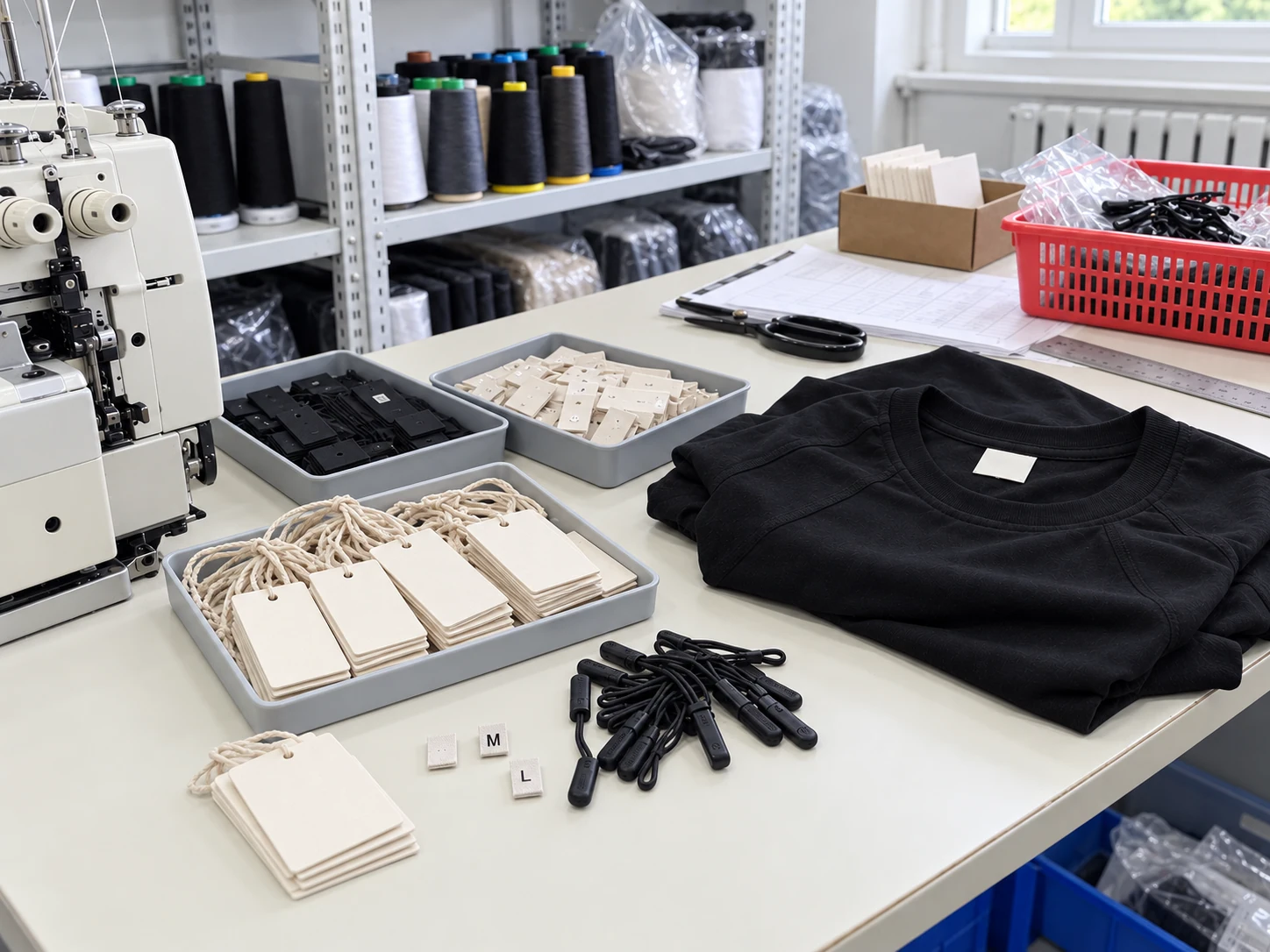
Specify the label material, finished dimensions, print process, folded edges, seam allowance and attachment position in the manufacturing brief. Ask for a production-intent printed sample, rather than approving only a large PDF viewed on screen. Check that sewing does not cover instructions and that a folded panel opens far enough to read. Photograph the installed sample and retain its physical reference.
For riding apparel, include the label in the sample's contact and dressing review. Check the proposed position while the garment is worn with the intended layers, and record any discomfort or interference requiring correction. Assess the label and attachment after the agreed care review for continued readability and secure attachment. Set the assessment conditions with the responsible team; this guide does not prescribe a universal label material or number of wash cycles.
Keep artwork approval distinct from print release
Use a unique artwork filename and revision, linked to the garment specification and destination register. Include the complete panel arrangement, language order, symbol references and any separate composition information. Ask the printer to return a proof showing the actual finished size and the portion reserved for sewing. Compare the proof with the controlled file, including punctuation, numbers and restrictions.
State what each approval permits. Content approval can authorise preparation of a print proof while a physical sample remains pending. Print release can authorise a defined label quantity and revision without releasing the garments for shipment. Give purchasing, the printer and the sewing team the same release instruction. Archive superseded proofs so an old attachment cannot be mistaken for the current file.
Connect the installed label sample to the wider garment sampling and approval checklist.
Use a care label approval record the next team can follow
Copy these fields into the project's approval log. Complete them by style and by the market or colourway differences that affect the decision. A blank field means unresolved; it does not mean that a requirement has been checked and found unnecessary. Keep the evidence files accessible to the people who will purchase labels and approve the labelled garment.
- Article and scope: style code, garment revision, colourways, bill-of-materials revision, destination countries and intended sales arrangement. Name the market-review owner and any unresolved scope or exemption question.
- Instruction evidence: proposed care route, warnings, supporting report or other evidence IDs, sample identities, reviewed components and whole-garment considerations. Record who accepted the evidence and which questions still need an answer.
- Presentation review: exact wording, languages, symbol system and edition, technical review status, and any required symbol-use authorisation reference. Link the reviewed translation rather than relying on an unrecorded message.
- Physical specification: label material and size, print and artwork revision, fold and sewing allowance, attachment position, installed-sample ID and checks for readability, attachment and the proposed care conditions.
- Sale presentation: packaging or folding arrangement, visibility of the sewn label, and any additional care information required for the approved destination. Reference the reviewed packaging proof where it affects access to the information.
- Release decision: approved, held or approved only for a named intermediate step; reviewer and date; permitted print quantity and revision; outstanding actions, owners and deadlines. Identify where the retained proof and labelled sample are held.
Before issuing the record, ask the purchasing colleague to identify the file they would send to the printer. Ask the sample team which physical label they would sew in. If their answers point to different revisions, keep the release on hold until the references agree. This is a useful handover check even when the same person has coordinated the whole development.
Hold only the decision the evidence has not closed
Consider a hypothetical white-bib shirt. The buyer has accepted the care evidence for the nominated body and bib assembly, but the printer's proof uses an unreviewed symbol file and the installed label sample has not arrived. Record those two open actions and their owners. The care-evidence review can remain complete while bulk label printing stays on hold. This is an illustrative approval situation, not a REINFORM order or a reported test result.
If a later component substitution changes the basis of that evidence, reopen the affected review as well. Keep the earlier decision identifiable, explain what changed and ask the responsible reviewer which evidence or sample work must be repeated. An updated artwork date alone does not show that the substituted garment has been considered.
Carry the approved revision into production and reorders
At production handover, connect the released label reference to the purchase order and garment specification. Require changes to the material, finish, decoration, care wording, symbol file or label construction to be reported before the affected work proceeds. Let the responsible reviewers decide what must be reassessed. Avoid allowing a replacement trim or a printer's layout adjustment to pass as an administrative change without review.
Check that the labels delivered and attached match the released version, and record discrepancies through the project's correction process. For a reorder, confirm the destination list, current garment specification and continuing validity of the instruction and artwork review. Release a named revision for a defined order, with open conditions visible to purchasing and production. That gives the buyer a usable record when a later question concerns what was authorised to be printed.
These references cover supplier processes, textile testing and market-specific labelling. They do not certify REINFORM or set the terms of your order. Confirm the product specification, destination requirements and quotation with your team.
Bring the label decisions into your garment brief
Send the proposed style, materials, destination markets and current label artwork, with unresolved instructions, evidence or permissions marked. We can use those details to discuss the manufacturing brief.
Start a garment development brief