 REINFORM
Begin with failure in use, not a standard number
The useful first question is not “Which tests do you offer?” but “What must this fabric keep doing in this garment?” Map the actual wearing and care conditions. Riding tights need controlled stretch and recovery through repeated flexion. Breeches combine movement with concentrated rubbing at the inner leg and seat. A white show shirt needs appearance and staining control. A brushed winter layer may need a surface assessment after wear and washing. An outer shell may justify weather-related tests only if the product brief makes a corresponding performance claim.
Write each risk as an observable failure: knees bag after wear; a waistband grows; a navy fabric stains a light layer; a panel pills; length changes after laundering; or colour moves visibly between approved swatch and bulk. Then decide which failures warrant laboratory evidence, which can be controlled by inspection, and which need a garment trial as well. Fabric testing does not replace fit, seam, trim or whole-garment approval. It answers defined material questions under controlled conditions.
Keep method, conditions and acceptance criteria separate
A test method explains how a property is measured or assessed. ISO 105-X12, for example, covers resistance to colour rubbing off and staining another material and allows dry and wet rubbing tests. ISO 12945-2 uses a modified Martindale method to assess pilling, fuzzing and matting. ISO 20932-1 covers strip methods for elasticity and related fabric properties. These titles identify different questions; they do not make the commercial choice about what result your product must achieve.
The conditions narrow the request further: fabric face or reverse, wale/course or warp/weft direction, dry or wet, as received or after care, number and type of care cycles, colourway, assessment stage and any agreed method option. The acceptance criterion is the brand’s numerical or graded limit, or an agreed “report only” instruction where evidence is still being collected. Use a limit taken from an applicable legal requirement, an established buyer protocol or an internally approved product standard. Do not invent one from a test method title.
A report can therefore be technically complete yet commercially undecidable: it may name a method and give a result, but show no client requirement. Conversely, a spreadsheet saying “pilling: pass” is weak evidence if it omits the method, exposure stage and specimen identity. Put method and criterion in separate columns so neither disappears.
Define exactly what the laboratory will test
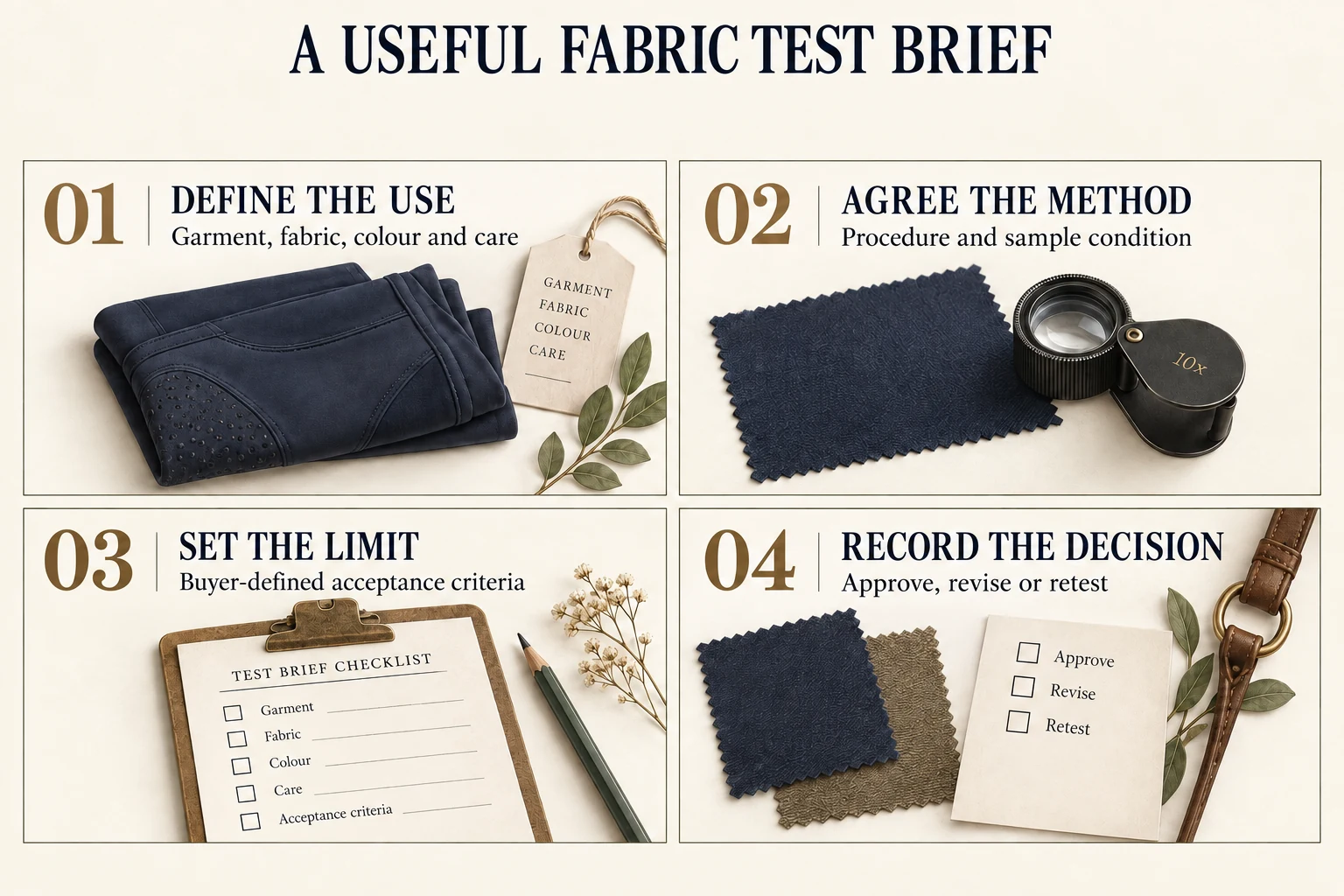
Tie every submission to a traceable material: project or style, supplier, mill article or quality code, fibre composition as declared, nominal mass, knit or weave, finish, colour, dye lot where available, sample stage and submission date. Attach the care instruction intended for the product when wash-related work is requested. The report description should let a later reviewer match the result to the approved material record without relying on memory.
Decide whether the specimen represents an early development quality, a production-intent lab dip, pre-production yardage or bulk. A result on an undyed development fabric does not approve a dark production colour. A finish, print, brushing process or coating can change behaviour, so record differences rather than carrying results across automatically. Use risk to set colour coverage: a practical plan might test every colour for rubbing and colour change, while a clearly justified physical-property programme tests the production quality plus selected worst-case variants. That is a planning example, not a universal sampling rule.
- Identify: style/project, material code, supplier, construction, declared composition and nominal mass.
- Trace: colour, dye lot or batch where available, finish, sample stage and submission date.
- State the end use: garment type, body zone, expected care route and any performance claim under review.
- Control the return: request remaining specimen retention or return where later comparison may be needed.
Replace “four-way stretch” with measurable behaviour
“Four-way stretch” describes a direction concept, not a result. For a riding tight or close-fitting base layer, the buyer needs to know what is being measured in both principal directions: extension under the selected test conditions, recovery after the specified extension or load, and residual growth after a stated recovery period. ISO 20932-1 describes straight-strip or loop methods for measuring elasticity and related properties in fabrics. Ask the laboratory which method options and reported outputs fit the material before you lock the protocol.
Connect the results to the garment. High extension can help dressing and movement but does not by itself show that knees, elbows or a waistband will return to shape. Recovery matters where sustained deformation would affect fit. Direction matters because a fabric can behave differently across and along its structure. Fabric figures still need a worn sample review: pattern reduction, seam construction, grip application and pocket layers alter how the finished garment feels and recovers.
If your team has no approved limit yet, request full results rather than a forced pass/fail. Compare candidate qualities under the same method, build a provisional range, and validate it against garment trials before making it a brand specification. Label any example target in the brief as provisional until that work is complete.
Review the development priorities for private label riding tights.
Make care conditions part of the dimensional test
Dimensional stability is not one generic “shrinkage test”. ISO 5077 determines dimensional change after an appropriate combination of specified washing and drying procedures. The selected care route is therefore part of the request. State the washing and drying procedure, number of cycles, measurement directions, whether the work is on fabric or garment, and what change is acceptable in each direction.
Choose conditions that match the proposed care instruction and likely use, then check that the final label and test brief agree. Record positive and negative change consistently so “growth” is not mistaken for “shrinkage”. For knitted riding wear, ask whether spirality or appearance after care needs a separate assessment; a length-and-width result alone may not capture twisting, puckering, delamination or surface change. Whole-garment confirmation is valuable when panels, elastics, bonding or trims respond differently from the base cloth.
Care performance should be resolved before final measurements and packaging are treated as fixed. A stable fabric does not excuse an unstable component, and a passing fabric report cannot predict every interaction in the assembled garment.
Choose colourfastness tests around contact and colourway
Colour risk depends on where the fabric sits and what it touches. Dry and wet rubbing are relevant where deep shades contact skin, pale layers or another garment panel. Laundering can produce both colour change in the original fabric and staining of adjacent material, which are different observations. Perspiration, water or light exposure may be relevant when the end use and claim justify them. Select the smallest test set that covers credible failure, rather than ordering every colourfastness method by habit.
State which colourways are submitted and whether contrast components should be assessed together. Dark, saturated shades, prints, fluorescent colours and contrasting combinations can present different risks, but colour alone does not prove which sample will perform worst. Where the consequence is high, test the actual production-intent colours instead of assuming that one shade represents the range. Review the report for colour change and staining outputs separately and compare each with its own criterion.
Do not turn a physical-performance article into a chemical compliance shortcut. UK and EU chemical, labelling and product requirements need a separate market-specific review using current official sources and the responsible business’s product details. A colourfastness result is not evidence of chemical compliance.
Treat pilling and abrasion as different questions
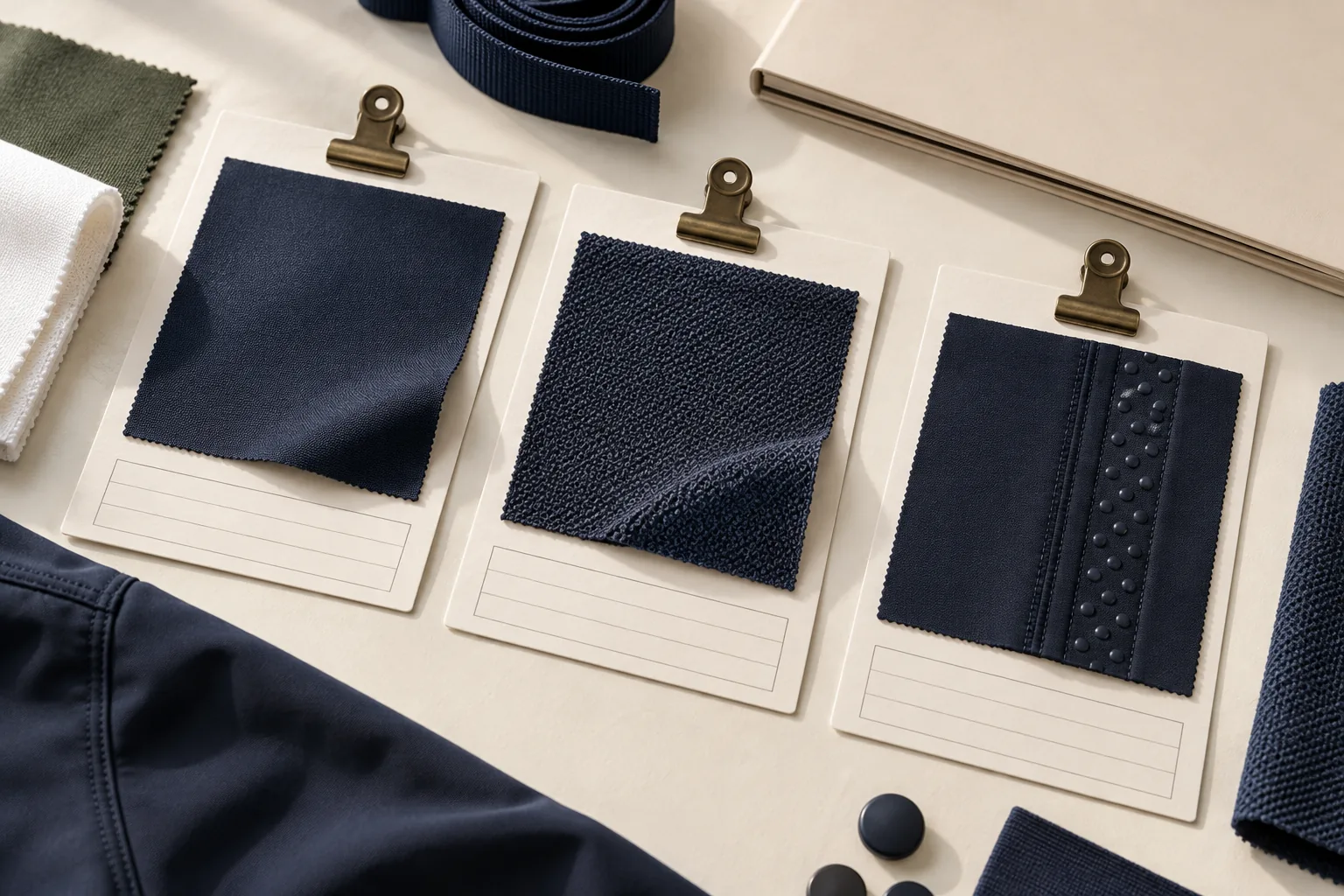
Pilling describes surface pills, fuzzing or matting under the selected assessment method. Abrasion testing can address other outcomes, such as specimen breakdown or mass loss, depending on the method chosen. Similar equipment names can hide different endpoints. A request for “Martindale” without the full property and method is therefore incomplete. Specify whether the concern is appearance, material breakdown or another defined endpoint.
For equestrian garments, locate the risk before selecting the test. A brushed inner face, seat area, inner calf, pocket edge and mesh insert do not share the same surface or exposure. Test the face that will experience contact and record whether the specimen is assessed as received or after care. If grip print, lamination or brushing is central to the risk, ask whether the relevant finished composite can be tested; a result from the unmodified base fabric may answer the wrong question.
A laboratory method accelerates a controlled mechanism; it is not a promise of a precise number of rides or washes. Use the result to compare against the agreed criterion and combine it with garment trials, construction checks and bulk inspection.
Send a test request that can be quoted without guessing
A good request lets the laboratory confirm feasibility, specimen quantity, cost and turnaround before material approval holds up the production calendar. Ask it to flag conflicting care conditions, insufficient sample size, unavailable method options and any deviation before testing starts. Do not accept silent substitutions between ISO, EN, BS, AATCC or an in-house method: they may answer a similar question but are not automatically interchangeable for trend comparison.
- Project and specimen: style, material code, colour, lot/stage, finish and intended garment zone.
- Use risk: the failure the test is intended to control.
- Property and method: complete designation and edition if your protocol controls editions; include options and directions.
- Conditioning or pre-treatment: as received or after a defined care route and cycle count.
- Acceptance criterion: limit for every reported output, or clearly marked report only.
- Reporting: raw result or grade, units, individual readings where needed, photographs for visual assessments, deviations and pass/fail basis.
- Administration: required sample quantity, quotation, turnaround, report recipient and purchase-order reference.
- Decision control: approver, deadline and action for pass, borderline/inconclusive or fail.
For example, “stretch and recovery test” is too loose. A quote-ready line identifies the material and directions, exact agreed method, pre-treatment, requested outputs, provisional or approved limits and the required report format. Any numbers in an early RFQ should be labelled as hypothetical until your technical team approves them.
Read the report before making the bulk release decision
Start with identity, not the pass/fail box. Check the report number and date, applicant and laboratory, specimen description, colour and stage, method and edition, conditioning or care procedure, test direction, units, individual and summary results, acceptance criterion, deviations and authorised sign-off. If accredited work is required, ask the laboratory to confirm that the relevant activity appears within its current accreditation scope.
Where a laboratory states conformity, understand the decision rule used near an acceptance limit. Intertek’s published softlines guidance illustrates that measurement uncertainty and a guard band can lead to pass, conditional or fail outcomes around a boundary. Ask how your chosen laboratory handles borderline results before the first report arrives, then write that treatment into the approval route. Do not recalculate or rename a conditional result informally.
- Release: specimen matches the intended material, required results meet approved criteria, and no unexplained deviation affects validity.
- Hold: identity, method, criterion or report detail is incomplete; obtain a corrected report or technical clarification before deciding.
- Retest: use a documented reason, representative replacement specimen and the pre-agreed retest rule; do not keep testing until a favourable result appears.
- Change and revalidate: adjust fabric, colour, finish, care route or garment design, then define which affected tests must be repeated.
- Reject: a confirmed failure creates an unacceptable product risk and no approved corrective route is available.
File the approved report with the matching fabric specification, colour approval, care instruction and decision record. Note what the result does and does not cover, including untested colours or later material changes. This creates an auditable link from product risk to bulk release without pretending that composition, GSM or a supplier adjective proves performance.
Use the sampling checklist to connect fabric approval with the finished garment.
These references cover supplier processes, textile testing and market-specific labelling. They do not certify REINFORM or set the terms of your order. Confirm the product specification, destination requirements and quotation with your team.
Bring the fabric requirements into your development brief.
Share the garment type, intended care, colourways and any buyer test protocol. Include the questions still open so the material and sampling requirements can be discussed together.
Discuss your fabric brief