 REINFORM
Name the seam and the failure you need to understand
Begin with a garment location, not a generic product category. A breeches seat seam, outer-leg seam, knee-grip attachment, waistband join and pocket opening differ in shape, layers, loading direction and construction. A show-shirt side seam, shoulder seam and sleeve setting also have different assembly details. Mark the seam on a simple garment sketch or photograph and give it a stable identifier, such as ‘Breeches A / inner-leg join / S-03’. If the path curves, note where it curves and whether a specimen can represent the critical area. Do not assume a straight laboratory strip represents every curved or intersecting garment seam.
Then state the question in observable terms. Are you checking whether stitching breaks before the fabric, whether yarns move at the seam, whether the sewn line opens under a specified laboratory load, or whether a construction revision changes measured seam performance? These are related but not interchangeable outcomes. Identify the concern that prompted the request and the intended decision: compare two approved construction options, screen a development assembly, investigate a documented production defect, or verify an agreed requirement. A test request should not imply that a laboratory pull test reproduces a rider’s movement or predicts how many rides a garment will last.
Keep the garment-use context concise and specific. Describe where the seam sits, whether it is close-fitting or under expected extension, what other panels or components meet there, and what failure would matter to the user or repair decision. This context helps the laboratory discuss a relevant specimen and helps the buyer decide whether the method addresses the real question. It does not turn the test into a wear simulation. A separate garment trial may still be needed to assess fit, comfort, mobility, appearance and interactions that a prepared specimen cannot reproduce.
Describe the complete assembly, not just its fabric
The seam is a system of joined materials and sewing choices. Identify the garment or project, style and revision; fabric supplier and article or quality code; fibre composition as declared; woven or knitted structure; nominal mass; finish; colour and sample stage. Record each layer that enters the seam, including lining, grip, elastic, tape or reinforcement when present. A test on one fabric colour or development swatch does not automatically represent a different production fabric, finish or layered construction. Preserve the material identifiers so the report can be matched to the approved specification.
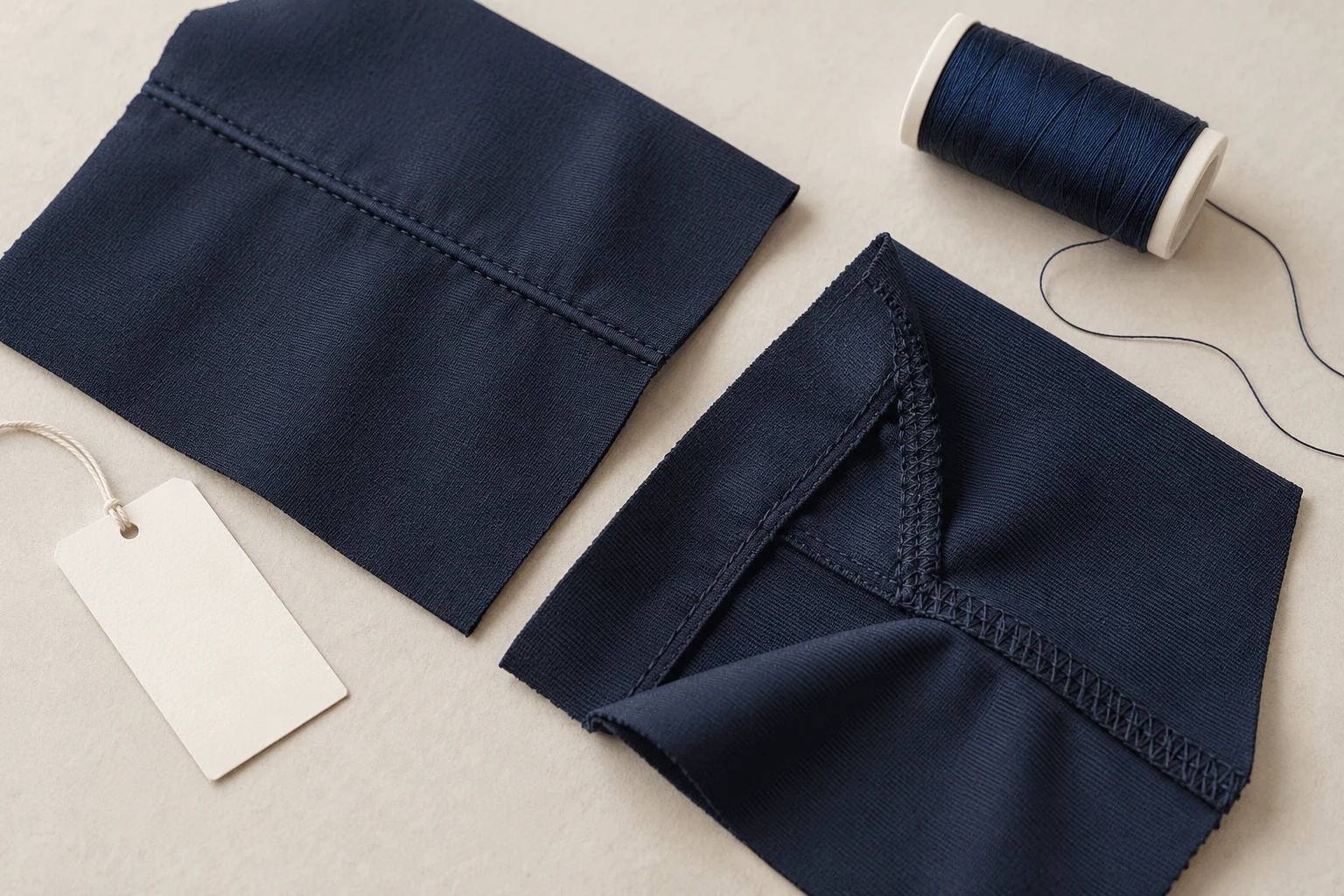
Describe how the assembly is sewn as far as the production record allows: seam type, stitch type, number of rows, stitch density, seam allowance, thread type and ticket or size, needle information if controlled, and any relevant machine operation or finishing. Note whether the sample is cut from a sewn garment or made as a specimen, who prepared it, and whether it represents a development, pre-production or bulk-intent build. The point is not to prescribe one stitch or thread for all riding apparel. It is to prevent a laboratory from receiving an unidentified strip that cannot be related to the garment decision.
If a construction detail is unknown, mark it as unknown and ask the factory or laboratory to confirm it before testing. Do not replace a missing detail with an assumed standard construction. A seam allowance or stitch density taken from a generic example may produce a specimen that is easier to test but unlike the production garment. Keep the approved construction reference and specimen reference together, and record any difference between them. If the tested sample changes after the report, the buyer should decide whether the change is material enough to require fresh evidence.
Check the method scope before choosing a test name
For woven fabrics, ASTM’s catalogue page for D1683/D1683M-22 uses the title ‘Standard Test Method for Failure in Sewn Seams of Woven Fabrics’. The historical D1683/D1683M-17e1 public scope describes measuring sewn seam strength in woven fabrics by applying force perpendicular to the seam, and cautions that the method does not predict actual wear performance. Confirm the current edition’s full scope and requirements with the testing laboratory before commissioning. The practical boundary remains important: controlled evidence about a specified seam specimen is not a prediction across every ride, care cycle, body shape or production variation.
ISO 13935-2:2026 is the current published second-part grab method for determining maximum force to seam rupture. ISO’s public abstract describes woven fabrics, including woven fabrics with stretch characteristics from elastomeric fibre or treatment, and says the method applies to straight seams rather than curved seams. The abstract says it may apply to fabrics made by other techniques, but that is not a blanket confirmation for every knit or garment construction. Tell the laboratory if the material is knitted, coated, laminated, highly extensible or curved, and ask it to confirm a suitable method, specimen preparation and limitations in writing. Do not cite ASTM D1683 as a universal knit-seam method.
The method name does not define your commercial pass limit. Ask the buyer’s technical owner to state whether the aim is comparative development data, an approved minimum, or investigation of a failure. If no acceptance criterion exists, request the measured results and failure description without forcing a pass/fail label. The buyer and supplier can review the evidence and decide whether to set a provisional criterion for a defined construction. Never borrow a threshold from a different fabric weight, seam, garment category or laboratory programme as though it applied automatically.
A textile laboratory’s public capability page can help identify a provider to contact, but it is not proof that a specific site is accredited for the exact method and material scope you need. Ask the selected laboratory for its current method scope, specimen requirements, accreditation status where relevant, report outputs, turnaround and any limits for the exact sample. The laboratory—not a marketing page—should confirm whether it can perform the requested method on your construction.
Send a brief the laboratory can quote and the buyer can decide from
Use a controlled request with one line per assembly. Include: project and style; seam ID and garment location; sketch or annotated photo; material codes and structure; specimen stage and colour; layers; seam and stitch construction; seam direction and whether the path is straight or curved; the exact method and edition requested or a request for laboratory advice; intended comparison or decision; buyer-owned acceptance criterion, if one exists; conditioning or care state, if relevant and agreed; requested result fields; sample quantity confirmed with the lab; and report due date. Attach the specification revision and name the person who will decide what the result means.
A concise request might read: ‘Style EQ-27, inner-leg seam S-03, production-intent woven stretch fabric F-12 navy, one-layer assembly with approved thread and construction revision C; specimens taken from the stated garment zone and marked for orientation. Please confirm whether the requested woven seam-strength method and specimen geometry are suitable for this seam. Report method and edition, specimen identity, orientation, measured result and observed failure mode. Compare revision C with revision D only if the laboratory confirms the specimens are sufficiently matched. No numeric acceptance limit has yet been approved; return data for technical review.’ This example is a brief format, not a report, tested result or recommended threshold.
When comparing revisions, change one relevant construction variable at a time where practical. Keep the fabric lot, colour, specimen orientation, sewing operator or documented sewing conditions, preparation and laboratory method consistent. If several variables change together—thread, stitch, seam allowance and reinforcement—the result may show that the assembly changed, but it will not isolate which change drove the difference. Ask the laboratory how many specimens it needs and whether the proposed comparison is technically meaningful; do not invent a sample count or imply statistical certainty from a small set.
A supplier may use its normal production sewing team to prepare representative specimens, but record who made them and how. The historical D1683/D1683M-17e1 public description notes that improperly sewn specimens can affect the result and discusses competent sewing preparation; confirm the current method’s preparation requirements with the laboratory. For a development comparison, inconsistent operator technique can obscure the difference you meant to study. Agree who prepares samples, how they are identified, and whether the laboratory will inspect them before testing. If a third-party lab prepares specimens, compare that setup with the intended production construction and document any gap.
Read the failure description alongside the force result
Start with identity and scope. Match the report number, date, laboratory, method edition, specimen description, fabric code, colour, seam ID, construction revision, direction and preparation notes against the request. If the report only says ‘navy breeches seam’, ask whether that identifies the tested assembly well enough. Check whether the specimen came from the garment or was separately sewn, whether a curved zone was represented, and whether any method deviation or limitation was recorded. Resolve a mismatch before treating the number as evidence for the production version.
Then read what failed. A report may distinguish thread or stitch rupture from yarn displacement, fabric failure or another observed opening, depending on the method and reporting format. Ask the laboratory to describe the observed failure mode and, where available, provide specimen images or notes. A maximum-force value alone cannot tell a product team whether an assembly is repairable, visually acceptable or comfortable. Nor does a high value automatically make one construction preferable: extra bulk, stiffness, seam visibility or restricted stretch may create other garment trade-offs that need separate review.
If the buyer has a criterion, confirm that it was agreed for this assembly and that the decision rule is clear. If results sit near a limit or differ between laboratories, follow the agreed dispute or comparison process rather than selecting the more convenient report. The historical D1683/D1683M-17e1 public description discusses comparative testing when buyer and supplier dispute results; confirm the process under the current agreed method. In practice, the parties can agree whether to send matched specimens to a mutually accepted laboratory, investigate sample preparation, or document a justified method difference. Do not infer a pass from an average, omit low results or merge unlike seam assemblies unless the agreed method and decision rule support that treatment.
Use laboratory evidence with the rest of garment approval
A seam strength result answers a narrow construction question. It does not replace fabric testing, garment fit approval, a wash-and-wear trial, component approval or a finished-garment quality inspection. REINFORM’s existing fabric-testing guide addresses material risks such as stretch and recovery, dimensional change, colourfastness and surface wear; this article focuses on the sewn assembly that joins garment components. The two evidence records can cross-reference the same style and material revision, but they should keep distinct scopes and decisions.
AQL inspection is also a separate lot-release decision. Sampling garments for workmanship defects is not the same as commissioning controlled seam specimens or choosing an engineering construction. A seam report does not prove that every bulk garment was sewn consistently, and an inspection sample does not establish the measured performance of a construction under a named method. Keep the evidence tied to the same approved style, factory revision and production stage so that a change in fabric, thread or operation triggers a reasoned review.
For an OEM or ODM development project, the useful outcome is not simply a test certificate. It is a decision trail: which seam was tested, why that seam mattered, what exact build was represented, which method was confirmed, what failure occurred, what criterion applied, and who approved the next action. REINFORM has operated its own factory since 2016 and can discuss equestrian apparel development and production planning. The buyer and laboratory should agree any specific test arrangement and acceptance criterion; no in-house laboratory or testing capability is implied here.
Read the separate guide to specifying fabric tests before bulk.
See how AQL inspection decisions differ from seam development evidence.
These references address seam strength in specified sewn assemblies. Public ASTM D1683 scope is for woven-fabric seams; the cited 2017 edition is a historical public scope, while the current edition’s full requirements should be confirmed with the laboratory. ISO 13935-2:2026 public abstract describes a grab method for woven fabrics and straight seams; suitability for knits, curved seams or a particular garment construction requires laboratory confirmation. Coats’ bulletin discusses thread and seam construction considerations, not REINFORM test results or a universal acceptance limit. This is guidance on method selection and evidence scope, not proof of garment wear performance, certification or in-house testing capability.
Brief the seam before sampling
Developing an equestrian garment? Share the seam location, material structure and approved construction revision so the right development questions can be discussed before bulk.
Discuss an OEM garment brief