 REINFORM
What must the first riding tights sample demonstrate?
Begin with the rider and training conditions. A lightweight summer tight, a brushed winter style and a junior pull-on product need different briefs. Identify the intended season, target body-size range, waistband shape, phone storage and seat or knee grip. State whether the tight is a stand-alone item or part of a coordinated collection. Include the intended destination markets and your proposed launch sequence, while distinguishing a target date from an agreed production commitment.
Keep the first comparison focused. If one supplier quotes a full-grip tight with two pockets and another quotes a plain legging with one pocket, the unit prices do not describe equivalent products. Prepare a fixed specification for comparison and a separate list of optional changes. Ask the equestrian leggings supplier to flag any uncertainty in the brief before quoting a substitute construction.
Choose the most informative initial sample rather than the easiest colour or size by habit. Explain what the sample must resolve: waistband security, stretch coverage, pocket access or another priority. A supplier may propose a development sequence, but your team should approve what each stage is expected to demonstrate. Keep unanswered questions attached to the project instead of assuming that ordering a sample resolves them all.
Compare high-rise, summer, winter and youth riding tights briefs.
Who will make the pattern, garment and grip?
Request the manufacturer’s business identity, production location and development contact. Ask which team will make patterns, review measurements, source the knit and manage the grip application. Establish whether decoration or other operations take place elsewhere and how the factory controls that work. The purpose is to understand the order’s route and accountability, not to assume that a single building must perform every operation.
Ask for construction evidence relevant to stretch garments. Discuss the proposed seam position, reverse-side feel, pocket reinforcement and transition between waistband and body. Request a comparable sample where sharing is permitted, or ask the supplier to explain the proposed assembly using your own brief. Do not require another customer’s proprietary pattern as proof of ability. A clear explanation of your garment is more useful than a catalogue of unrelated products.
Assess the quality of the questions you receive. A supplier that asks for phone dimensions, preferred rise and target fit is identifying decisions that influence construction. Record its assumptions in the development file. If it cannot distinguish fabric recovery from garment fit, or promises an unqualified performance claim without identifying evidence, keep that point unresolved until the response becomes specific enough to evaluate.
Which knit are you quoting, and how will it be identified?
Ask each shortlisted riding tights manufacturer to identify the proposed fabric quality, declared composition, nominal weight, finish and available colour route. Request a reference swatch or material code linked to the sample. “Four-way stretch” describes a broad characteristic; it does not explain how the finished tight will recover, retain coverage or behave after the intended care routine. A material name without a traceable reference makes later comparisons difficult.
Evaluate the proposed knit in the actual garment. Agree how your team will inspect coverage through the seat, thigh and knee at relevant stretch and wearing positions. Record lighting, underlayers, size and the review conditions, including damp assessment if the intended use warrants it. Treat this as a defined buyer evaluation. Do not invent a universal opacity threshold or assume that a photograph taken on a table proves coverage in use.
Separate a hand-feel preference from a measurable performance request. Intertek lists stretch recovery and moisture-related properties among its apparel testing services; this does not certify a particular fabric or establish your acceptance limits. Ask a competent laboratory to confirm the appropriate method and conditions when evidence is needed. Keep the report tied to the actual quality, colour and stage being approved, and record which claims remain unsupported.
Build a fabric test brief with methods, conditions and approval criteria.
How will you approve the mesh and main knit together?
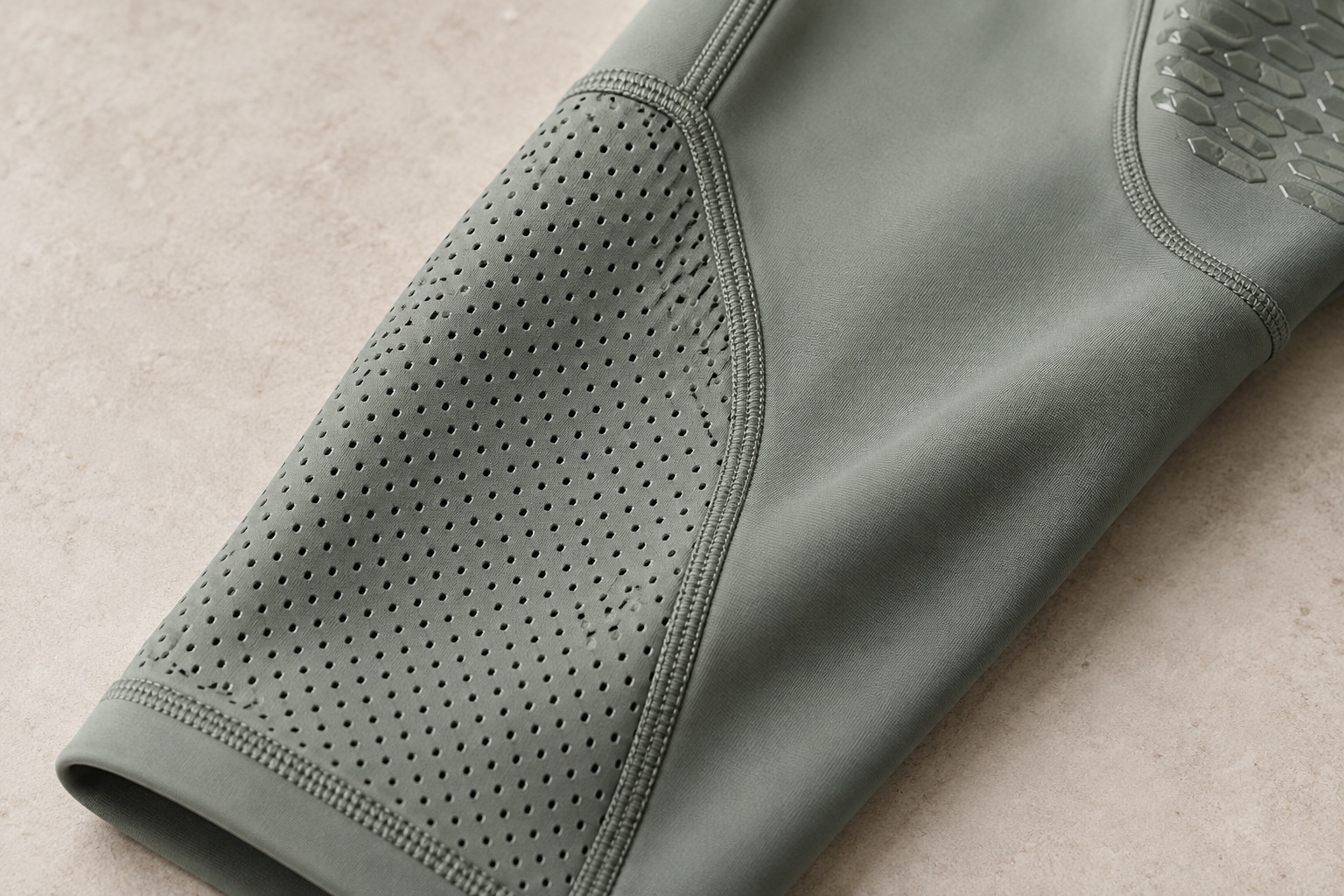
When shortlisting a factory for breathable mesh riding leggings, turn “breathable” into questions the supplier can answer. Which zones need ventilation, which must retain coverage, and where will the rider’s boots and saddle contact the garment? A summer brief should include a panel drawing with those areas marked. Ask the supplier to identify the main knit and mesh separately, including the proposed composition, weight, colour and finish. These are details to confirm for your order, not fixed specifications implied by a catalogue photograph.
For a comparable quotation, hold the panel boundaries, pockets and grip coverage constant. If a candidate proposes fewer mesh inserts or a different mesh, request it as an alternative with its own material reference. Otherwise, a cheaper offer may remove the very feature your team wants to evaluate. Keep material availability and colour matching visible in the comparison; a suitable main knit does not establish that the proposed mesh is available on the same schedule.
Review an assembled sample before approving the combination. Inspect the seat and thigh coverage in the intended colour and size, then examine the mesh boundary during bending and seated movement. Use the intended boots and load the phone pocket with the specified device and case. Record any seam ridge, panel pulling or waistband movement against those conditions. A flat swatch review cannot answer whether a seam sits under a boot edge or whether a loaded pocket distorts the light shell.
Repeat the agreed review after the proposed care sequence. Keep the same sample identification, measurement method and observation points so a change can be traced. If the mesh and shell recover differently or a junction ripples, ask the developer to propose a correction and identify what must be rechecked. Do not automatically tighten the whole garment to hide a local panel problem. A change to either material can reopen fit, colour matching and the relevant test requirements.
Airflow preference, moisture management and UV protection are separate questions. Decide which properties your brand actually intends to claim, then agree the evidence needed for those claims with the supplier and laboratory. A wearer describing a sample as cooler is useful development feedback; record the conditions and keep it distinct from a substantiated performance statement. The same distinction applies when a supplier shares a report for a different fabric or colour.
Prepare a mesh riding leggings factory brief with panel, pocket and material checks.
Does the fit review include a loaded phone pocket?
Provide a measurement sheet that distinguishes body measurements from finished-garment measurements. Specify where and how the waistband is measured, the intended rise and the proposed construction. Ask the OEM riding tights manufacturer to identify the pattern and fabric assumptions behind its sample. Changing the knit can change how the same pattern feels, so do not approve a fabric substitution solely because the flat dimensions remain unchanged.
Fit the sample in standing and seated positions, with bending and the movement appropriate to your rider profile. Record whether the waist rolls, shifts or creates local pressure and whether the crotch or leg seams pull. Note the sample size and wearer measurements so the observations remain interpretable. A tighter waistband is not automatically the solution to movement elsewhere in the garment; ask the developer to explain the proposed correction and recheck the result.
Use the intended phone and case, or a clearly specified equivalent, for the pocket review. Check insertion, removal, retention and whether the loaded pocket pulls on the waistband or seam. Repeat the movement review with the pocket loaded. Pocket appearance and garment fit are connected decisions, so separate approvals made under different conditions can miss a problem that appears only when the product is used as intended.
Who approves the grip layout and care result?
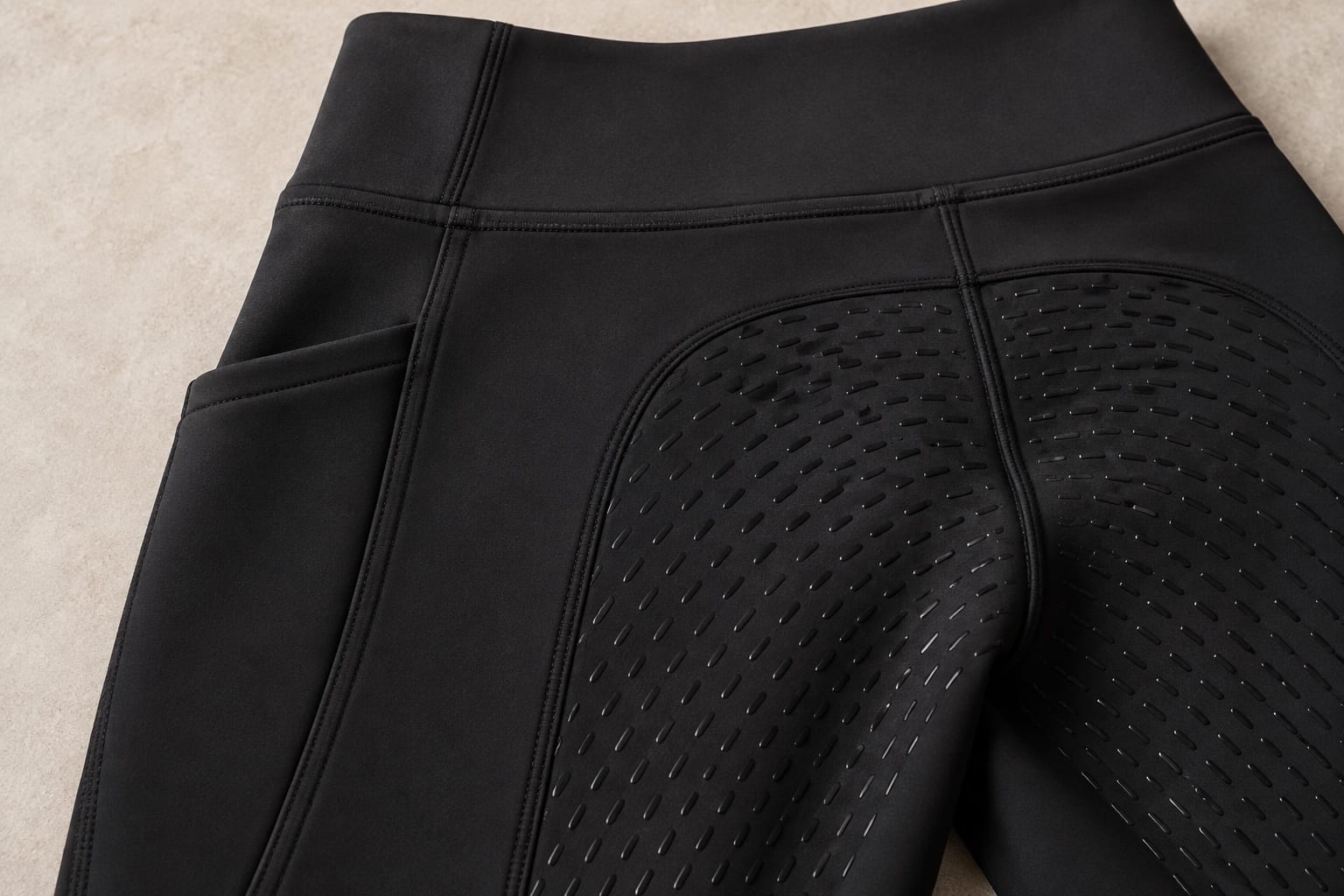
For a full-seat or knee-grip style, provide the artwork, coverage area and placement reference. Ask how the pattern is positioned across seams and graded between sizes. Clarify the proposed application route and which organisation is responsible for checking it. “Silicone grip” is not a complete instruction: the base material, design, placement and finished feel still need approval on the actual tight.
Agree a review plan for appearance, flexibility, surface feel and condition after the intended care process. Inspect the transition at edges and any areas where the design crosses a seam or stretches noticeably in wear. Record what your team considers unacceptable before reviewing the sample, and ask for a revised proposal when the application interferes with movement or produces an unwanted feel. Do not turn these observations into unsupported claims about universal durability or saddle protection.
If a supplier offers an existing grip design, establish what is being supplied and what customisation is possible. Confirm artwork rights and any tooling or preparation charges through your normal purchasing process. Keep an approved artwork file and physical reference linked to the style version. A later change in coverage, scale or material should reopen the relevant approval rather than being treated as a harmless cosmetic substitution.
Review the full-grip tight’s waistband, coverage and pocket decisions.
What do the MOQ and quoted price include?
Ask for the quantity basis in writing. A minimum might apply by style, colour, material purchase or another defined unit; do not assume every supplier uses the same one. Request the proposed size allocation and ask which changes would create a new style or require additional material. Keep fabric availability separate from the factory’s willingness to sew a small garment order.
At REINFORM, the minimum is 300 pieces per style, per colour. As an arithmetic example, one style in two colours means a baseline of 600 pieces, with the size breakdown to be agreed within each colour. That example does not predict which sizes will sell or establish another manufacturer’s terms. Use your own demand planning before increasing colours merely to fill a collection presentation.
Request separate costs for pattern development, samples, grip preparation, decoration, labels and packaging wherever they are not included in the garment price. Record quotation validity, currency, named delivery scope and the handling of revisions. REINFORM’s sampling baseline is 7–10 working days and bulk production 30–45 working days from the agreed start; revisions, material confirmation and transit need separate planning. Compare each supplier’s written milestones rather than substituting those figures into every offer.
Who signs off sizes and destination artwork?
An approved base-size sample is not approval of every size. Ask the manufacturer how the proposed grading will be reviewed and which sizes your team should assess before release. Record the measurement method and correction history so a fit change reaches the size specification as well as the next sample. A junior range requires its own development and destination review; reducing an adult pattern is not sufficient evidence that a youth product is ready.
For US sales, assign a reviewer for the FTC’s textile labelling topics, including fibre content, origin and responsible-business identification, and separately review the basis for care instructions. For Great Britain and EU destinations, use the relevant official textile guidance rather than assuming the US artwork transfers unchanged. EU language requirements also need destination-specific attention. These are selected labelling references, not a complete product-compliance checklist.
Give the factory one released artwork set with version, placement and attachment details. Check the labels on the garment during fitting and care review. A correct file in an email does not show that the right version has been attached to every production size. Agree how artwork changes, approved substitutions and outstanding market questions will be recorded before the order moves beyond development.
Plan size-set approval for private label breeches and riding tights.
What evidence closes each question before bulk?
Make the supplier decision in stages. Shortlist for relevant capability and a clear response; commission development to resolve your highest-risk questions; release bulk only after the agreed conditions are met. A sample may justify continuing development without yet justifying a production order. Record that distinction so the buying calendar does not quietly turn a conditional response into approval.
For example, imagine a summer sample that meets the agreed seat-coverage review but whose loaded phone pocket pulls the waistband down. Record a conditional development decision: retain the accepted coverage reference, request a pocket-support proposal and repeat the loaded fitting before release. If the correction changes the side panel or fabric, check coverage again too. This hypothetical example shows why a sample should not receive a single undifferentiated “pass”. List accepted points, open corrections and the evidence needed to close each one.
For the production handoff, identify the approved sample, material, measurements, grip artwork, labels and packing instructions. Ask the supplier to explain how it will check these references during the order and how it will notify you of a proposed change. Agree inspection expectations, reporting and the commercial route for resolving differences. The buyer and manufacturer need the same reference set when discussing a problem after packing, not separate memories of what was intended.
Keep a question log alongside the sample record. Give each question its own row with the supplier’s answer, the document or sample reference supporting it, the buyer’s reviewer, and any action still due. “Mesh agreed” is incomplete if nobody has identified the material or approved its junction with the main knit. Replace it with the actual references and the review still required. When a later answer changes a fabric, panel or quotation, reopen the affected rows rather than treating the original conversation as permanent approval.
Use the following record for each candidate. Mark every item confirmed, pending or unacceptable, and add the evidence location and responsible person. Do not average an unresolved critical product issue into an otherwise favourable overall score.
- Manufacturing route: business identity, factory location, pattern and sampling contacts, outside operations and remaining verification questions.
- Knit proposal: material code, composition, finish, colour, coverage assessment and any required performance reports.
- Fit evidence: sample version, wearer and garment measurements, movement observations, loaded-pocket review and correction status.
- Grip approval: artwork version, placement by size, application responsibility, care review and unresolved conditions.
- Order scope: style/colour quantities, size allocation, development charges, unit-price inclusions, delivery responsibilities and agreed milestones.
- Release record: final sample reference, grading decision, labels, inspection plan, change-control owner and approval signature or recorded authorisation.
Before committing to a private label riding tights order, check that the answers describe the same product, price basis and approval references. Give each open question a named owner and next action. Retain this record with the accepted sample so that a repeat order starts from agreed decisions rather than a fresh set of assumptions.
Discuss private label development and sample approval with REINFORM.
These references cover supplier processes, textile testing and market-specific labelling. They do not certify REINFORM or set the terms of your order. Confirm the product specification, destination requirements and quotation with your team.
Bring a brief we can review.
Send a panel sketch, fabric references if available, pocket and grip requirements, and quantities per style and colour. Name the destination and the sample issue your team needs to resolve first.
Discuss your riding tights brief