 REINFORM
Decide what the colour approval releases
A lab dip is a small dyed-material submission used to develop and assess a proposed colour. CottonWorks describes a process starting with a brand requesting a specified colour on a specified substrate. The supplier develops a formula, measures the resulting sample and reviews it against the brand's requirements. The approved formula then moves towards production. The useful purchasing question is therefore precise: which colour, on which material, has been accepted for which next step?
Put that next step in the approval message. It might authorise preparation of a garment sample, a production trial or bulk dyeing, depending on your agreed development route. Identify any later hold before cutting or assembly. A message saying only “navy approved” leaves the mill, garment maker and buyer to infer whether it also covers pocketing, zip tape and subsequent dye lots.
Keep colour acceptance separate from performance acceptance. A pleasing shade does not establish wash fastness, rubbing resistance, stretch recovery or suitability for saddle contact. Track those requirements alongside colour, with their own evidence and decision owners. This lets the team progress an acceptable shade while keeping an unresolved material test visible.
Plan the separate material checks with the equestrian apparel fabric testing guide.
Set the lab dip approval conditions before dyeing
Send a short colour brief with the material request, rather than adding assessment rules after the first submission arrives. The following is a suggested buyer's checklist. It is a working agreement for the project, not a reproduction of a testing standard. Ask the supplier to flag missing information or an unachievable target before it starts the development round.
- Identify the colour target, its reference number and the current approved physical or digital standard.
- Name the fabric or component, including the agreed composition, construction, finish and material revision.
- Specify the visual assessment conditions and who has authority to make the colour decision.
- Where instrumental assessment is agreed, record the method, settings, colour-difference calculation and acceptance criteria.
- State which components must match or coordinate, and which items require individual approval.
- Define the submission route, decision record and later bulk or shade-lot checks needed before release.
If the purchase specification names a published procedure, include its edition. The AATCC public catalogue checked for this guide lists EP9-2025 for visual assessment of textile colour difference. Its published scope concerns comparison with a standard; the public page is only a summary. Naming it in a brief is not evidence that either party has read or implemented the full procedure. Confirm the required document, equipment and competence with the responsible laboratory or colour team.
Give every party the same usable reference
Choose one controlled target for each colour and identify how suppliers obtain it. A physical swatch, a named colour standard and a digital file need an explicit relationship. Record which reference governs the decision if they disagree. Avoid circulating several unlabelled cuttings and asking different suppliers to match whichever piece happens to reach them.
Ask whether the reference represents the intended material and finish. A smooth reference fabric can communicate a colour aim for brushed fleece, but the buyer still needs an accepted appearance on the proposed fleece. Record any agreed material-specific target without silently replacing the original colour brief. If an alternative is accepted, state whether it applies only to that component or changes the whole colourway.
Use photographs to show sample identity, arrangement or the area being discussed. Do not use an emailed image as the sole colour standard for a physical approval. When colleagues review different physical copies, confirm their reference IDs before debating the sample. A disagreement caused by different targets cannot be solved by repeatedly adjusting the dye recipe.
Use the material library to distinguish the fabrics being discussed in the development brief.
Read instrument results alongside the fabric's appearance
Datacolor's textile guidance combines measured data with controlled visual assessment. It explains that weave, texture, gloss, pile direction, transparency and fibre composition affect appearance. Two fabrics with similar measurement values may still look different under certain conditions. It also states that acceptable colour-difference tolerances depend on the material, application and customer requirements. There is no single Delta E limit to insert into every apparel order.
Before comparing reports from two parties, ask whether they used the same target and an agreed measurement procedure. A report needs enough identification to connect the result to the submitted material and its assessed condition. If the data and visual judgement disagree, hold the decision while the colour specialists check the reference, sample preparation and assessment conditions. Record the explanation rather than averaging conflicting conclusions into a pass.
For a brushed riding midlayer, note the face assessed and the direction of the nap on the submission record. Ask the colour team how the material should be presented for repeatable assessment. This is particularly useful when one colleague lays a cutting flat while another handles it in a different orientation. Preserve the agreed presentation with the accepted sample so a later reviewer can understand the decision.
Agree the viewing light across the supply chain
A match under one light can become a mismatch under another. Datacolor's light-source guidance recommends defining and communicating the relevant illuminants, aligning supplier assessment conditions and considering the selling or use environment. It also explains why colour temperature alone does not fully describe a source: lights with the same colour temperature can have different spectral distributions.
Ask the buyer's colour lead to specify the primary and additional viewing conditions required for the collection. Confirm that the supplier can reproduce them and that any instrumental assessment uses the corresponding agreed conditions. Avoid choosing a light-source combination because it appeared in another brand's manual. A club uniform used outdoors and merchandise displayed indoors may need different considerations; the project brief should resolve them.
If a sample is acceptable in the primary condition but visibly separates from its reference in another required condition, record both observations. Ask for a technical review before accepting the compromise. An approval with an exception should name the exception, the affected material and the decision owner. “Looks fine here” gives the next colleague little help when the same mismatch appears elsewhere.
Review the whole colourway, component by component
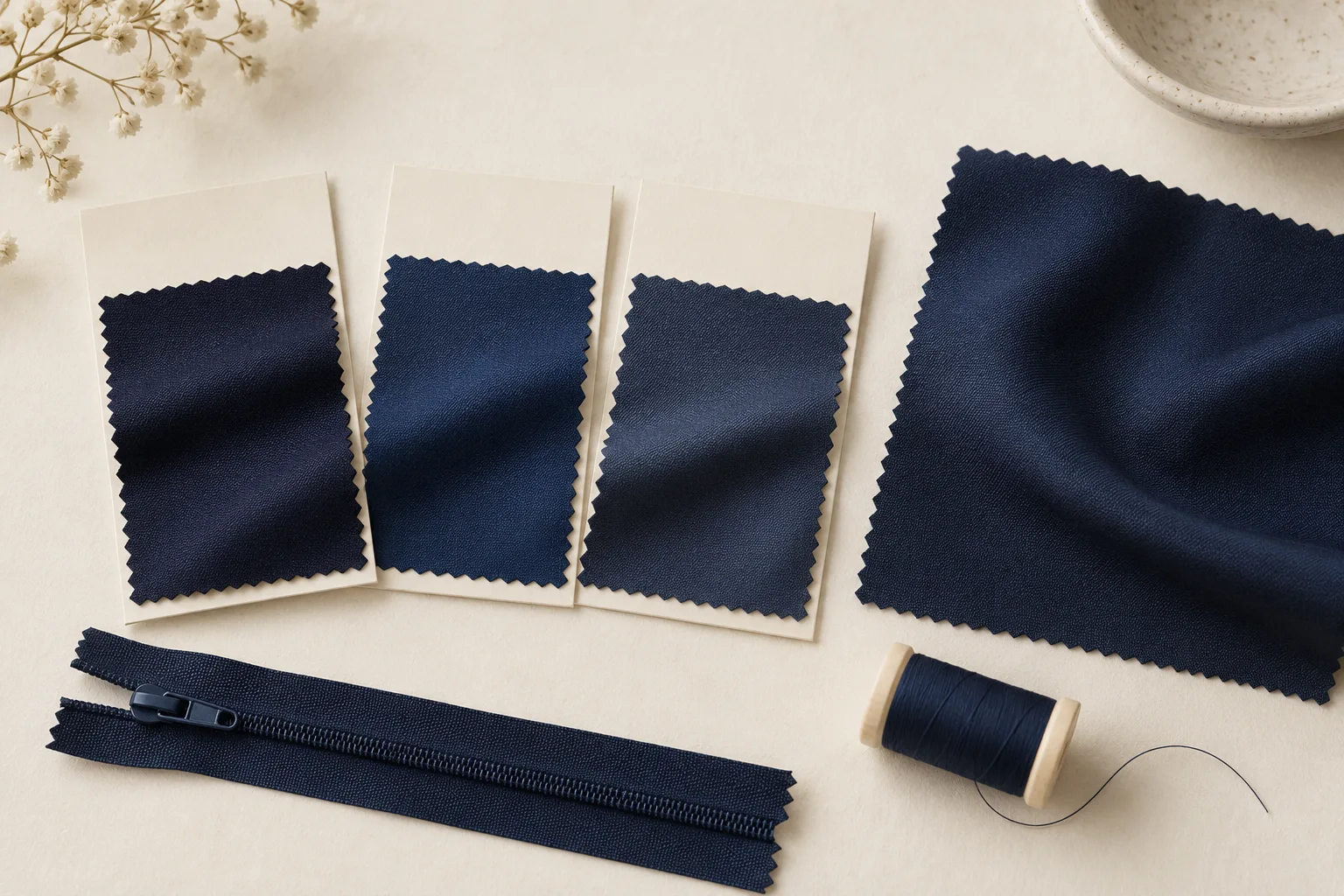
A navy outer layer may combine a fleece body, pocket fabric, binding, embroidery thread and zip tape. List these separately in the bill of materials. Mark whether each should match the body, coordinate with it or provide a deliberate contrast. Without that distinction, a supplier may pursue an exact match where the designer intended a tonal difference, while overlooking a component that should blend in.
Datacolor specifically discusses the risk of fabric and a zip matching in one light but separating in another. Its guidance calls for attention to products combining different dyes, finishes and substrates. Use that principle when arranging the component review: assess the proposed materials together under the agreed conditions, then retain their separate identities in the record.
Treat a material substitution as a reason to revisit the affected colour decision. Ask what changed, whether the existing approval still applies and which comparison must be repeated. Changing a fleece construction or replacing a trim is more than changing a supplier name in a spreadsheet. Keep the colour decision connected to the material revision that will actually be purchased.
Make each submission and revision traceable
Give each submitted option a unique reference and preserve the connection between its physical label, supplier message and report. A practical record includes the project, colourway, material revision, supplier, submission date and option ID. If the supplier sends several alternatives, make the final message unambiguous about which one was selected. An arrow in a photograph is a weak substitute for the labelled cutting.
Maintain one decision log with a status, reviewer, date, correction request and next action for each submission. Keep rejected and superseded references identifiable without presenting them as current options. If a colleague joins the project, they should be able to locate the accepted reference and the outstanding conditions without reconstructing a long message thread.
Retain the accepted physical sample according to the project's handling arrangements and record where the controlled copy is held. Before a reorder, confirm that the target and material specification remain current. Do not describe a previous season's approval as an automatic release for a changed material or a new production lot.
Write a correction the supplier can act on
Describe the observed difference against the identified target and state the conditions used. Include the agreed instrument report where relevant, alongside the visual comments. Avoid contradictory instructions from design, sourcing and merchandising by nominating one person to consolidate the decision. If an adjustment is requested, say which option it starts from and what the next submission must contain.
Those identifiers are examples, not a real order or colour result. The purpose is to show the information a correction should carry. If the supplier reports that the requested target cannot be achieved on the selected material, ask for clearly identified alternatives and their implications. The buyer can then decide whether to change the colour aim, material or component relationship before another round begins.
Carry the approved reference into bulk and shade-lot review
Lab dip approval does not finish production colour control. CottonWorks notes that adjustments may be needed when the formula is scaled up. A published DXL Group development guide dated August 2022 provides a buyer-specific example: it treats lab dips, bulk fabric, shade lots and trims as distinct approval activities. Its quantities, lights and deadlines are that brand's requirements, not universal settings for an equestrian order.
Agree who submits the first production material, what identifies its dye lot and which reference governs that comparison. State whether cutting must wait for acceptance. Where more than one shade occurs, ask for the proposed grouping and the quantity represented by each group. The buyer needs to decide how acceptable variation can be managed within garments and across the delivered order, rather than discovering mixed shades during packing.
Do not let an accepted bulk cutting quietly become a new colour target. If the project adopts a production reference, record the decision and its relationship to the original standard. For a rejected lot, keep the correction and resubmission route visible. Discuss the effect on cutting, assembly and delivery with the relevant teams before changing the schedule.
Connect colour-lot records to the finished-garment AQL inspection brief.
Close the decision with a usable release record
Before sending approval, read the record as the person responsible for the next production step. It should identify the accepted submission, current material specification, governing colour reference and assessment conditions. It should also say which components remain pending, what activity may proceed and which later checks are still required. Leave unresolved fields open rather than filling them with assumed values.
A useful release line follows this pattern: accepted submission and revision; applicable material and colourway; agreed assessment basis; authorised next step; outstanding conditions; reviewer and date. Attach or reference the supporting files through the project's agreed channel. That gives the supplier a decision it can follow and gives the buyer a reference it can use when the first bulk fabric arrives.
These references cover supplier processes, textile testing and market-specific labelling. They do not certify REINFORM or set the terms of your order. Confirm the product specification, destination requirements and quotation with your team.
Prepare the colour brief for your outerwear project
Send the proposed materials, colour references and quantities, together with any undecided viewing conditions, tolerances or bulk-release requirements. We can use those details to discuss the development brief. The MOQ is 300 pieces per style, per colour.
Start an outerwear development brief