 REINFORM
Freeze the supplier copy
A sample approval tells you which garment the brand accepted. A purchase BOM gives sourcing the component identity, quantity and unit to buy for the variants being produced. During sampling, a line may still describe an option or identify a component by a workroom nickname. By the time a buyer is committing money, each released row should point to a part the supplier can identify and supply against the order.
Put the style, garment order reference, revision number, issue date and approval status in the header. Add the approved sample reference and the technical pack revision. Agree who owns the master and who can authorise procurement. The production partner needs the supplier-facing release with its purchase-relevant fields and approval references, even if the brand keeps costs or other internal notes in a separate working file. Ask the recipient to confirm the revision and flag any line they cannot supply as specified.
One style can carry shell fabric, lining, thread, closures, labels and packaging, with different dimensions or finishes by colour, size or destination. WFX's tech pack documentation shows how an apparel BOM can carry components, quantities, colours and supplier details inside a versioned technical file. Gerber YuniquePLM's Dimensions documentation shows how an apparel system can assign component quantities across colour and size combinations. The format can be a controlled file or a system record. The test is whether a buyer can trace each order line back to the agreed component and scope.
Give the person reading the file an unambiguous purchasing status. A row marked ‘sampled’ may still lack the bulk supplier code or a confirmation that the sample finish can be repeated. Mark it pending with an owner and date. For any authorised subset, state exactly what procurement may release and which order it belongs to. A revision can then include open decisions for the rest of the style without accidentally making them available to order.
Use the sampling checklist to link the purchase file to the right approved garment.
Show colour and size on each row
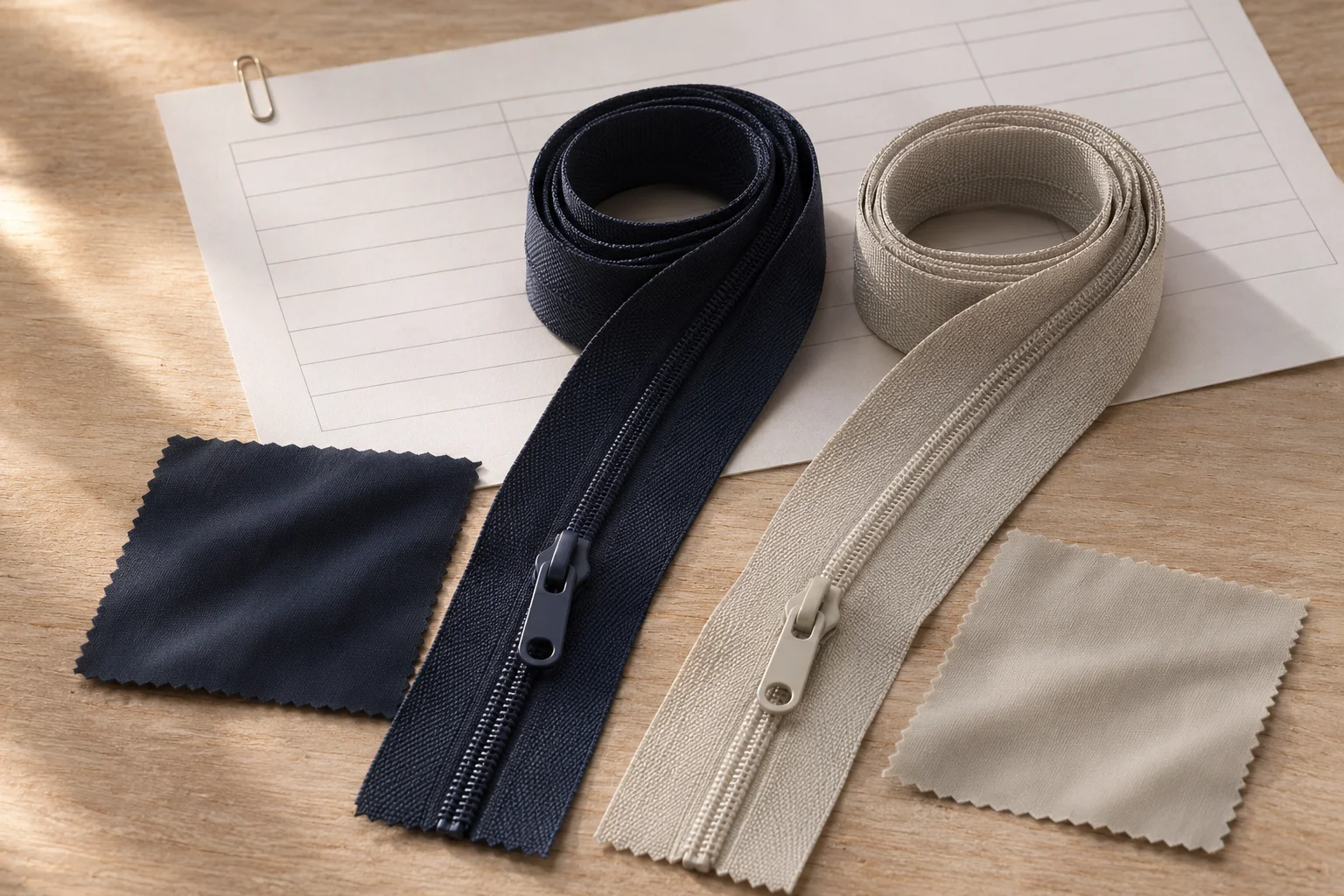
Give each purchasing row a stable internal ID and enough information to distinguish it from similar rows. For a front zipper, record its garment placement, supplier and part code, opening type, tape shade reference, slider and pull specification, finish and length. YKK's dimensions guide shows that the points used to define length vary by zipper configuration. Use the supplier's agreed measurement convention and specify it on the row or in the attached component drawing. A bare number in centimetres leaves room for two plausible readings.
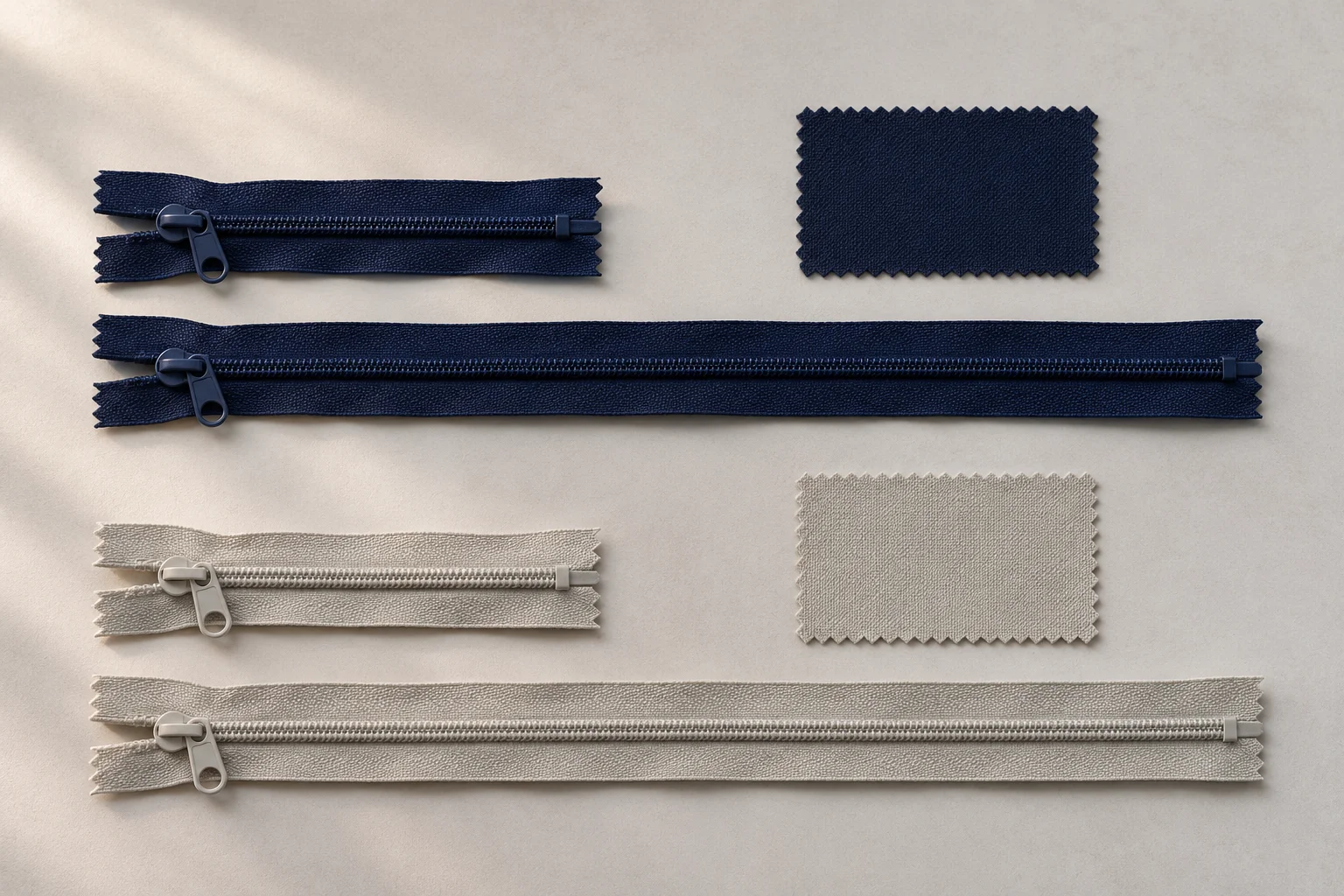
Consider a hypothetical one-way separating front zipper for jacket J-24, originally supplied by Supplier A as component family Z10. Revision 03 assigns one zip per jacket across two colourways and two length groups. For these example rows, 55 cm and 60 cm use the same agreed reference points from the slider head to the end of the separating assembly, measured with the zip closed. The codes, dimensions, shade references and quantities below are invented.
- FZ-N-55. Navy, S–M, Z10-N55, tape swatch N1, 55 cm. One piece per jacket and 120 jackets in this group.
- FZ-N-60. Navy, L–XL, Z10-N60, tape swatch N1, 60 cm. One piece per jacket and 180 jackets in this group.
- FZ-S-55. Stone, S–M, Z10-S55, tape swatch S1, 55 cm. One piece per jacket and 140 jackets in this group.
- FZ-S-60. Stone, L–XL, Z10-S60, tape swatch S1, 60 cm. One piece per jacket and 160 jackets in this group.
Keep the underlying size breakdown in the order. Grouping S and M on one component row works here because both sizes use the same part. The component requirement is 600 zips before any agreed spare quantity or supplier pack rounding. Ordering simply ‘600 front zips’ would lose the shade and length split. Show the calculated requirement and any purchasing allowance separately so that the supplier can reconcile both against the released rows.
Check cross-references where a component is supplied as an assembly. If the pull is included in the zipper supplier's finished part, identify that on the zip row. If it is a separately purchased branded pull, give it its own row and link it to the zip assemblies that use it. When a substitution comes in, the buyer can then see whether the change affects one vendor line or two and whether existing stock can still be used.
Trace the substitute to affected rows
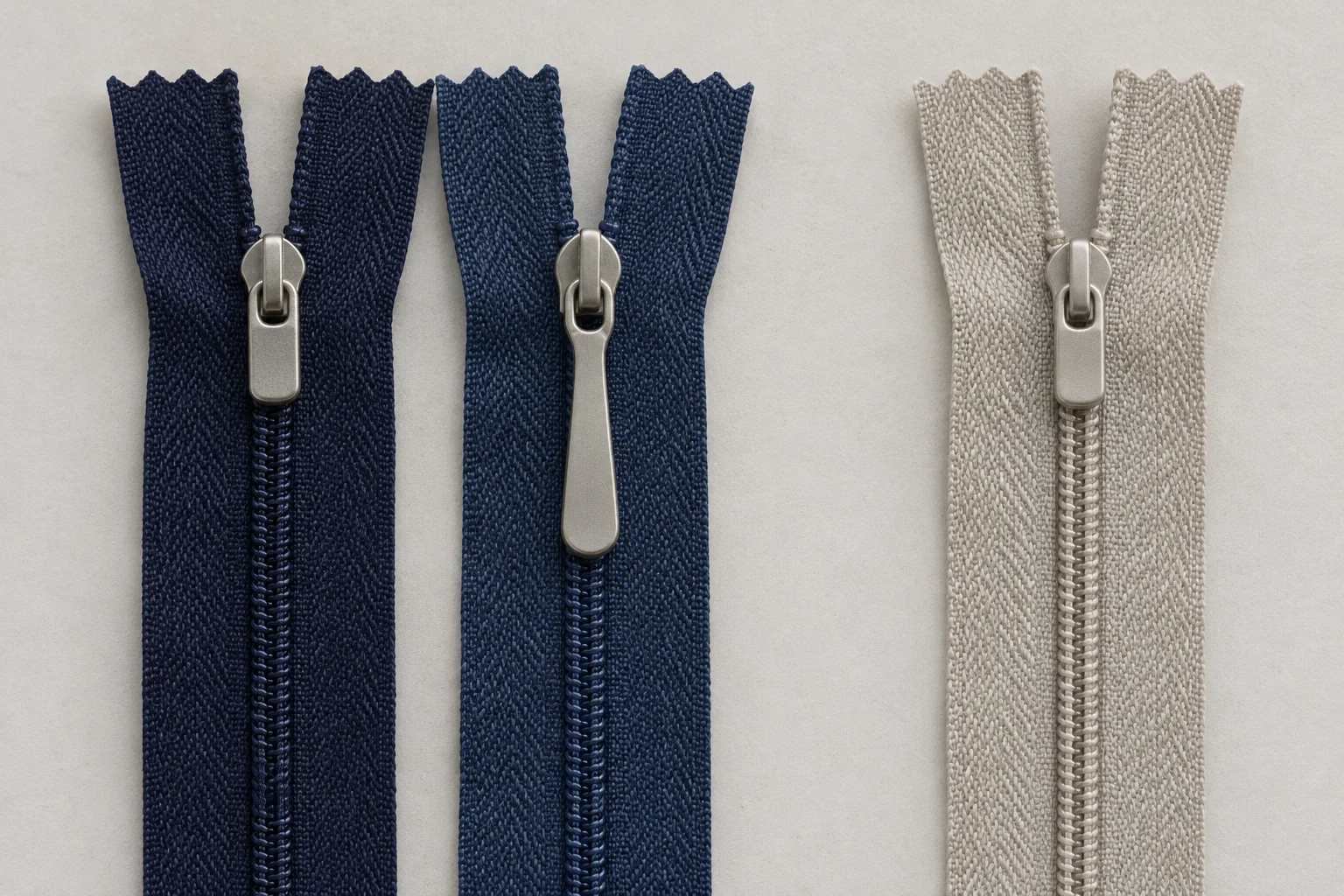
Suppose Supplier A says the Navy Z10 tape is unavailable for the order window and offers Z22 from its alternative range in both lengths. The candidate has a different tape reference and pull finish. Supplier A confirms both Stone Z10 variants can still be supplied under the original approval. Log the proposed change against FZ-N-55 and FZ-N-60. Keep the 120 and 180 Navy units separate so an approval for one length cannot be read as approval for both. The two Stone rows still point to Z10 and their Stone approval evidence.
Get the candidate codes, technical dimensions, tape and pull references, availability, pack quantities and commercial terms for both Navy lengths. Ask what changed on the zipper and what changed in the garment assembly that uses it. A supplier may describe a candidate as equivalent because it opens the same way and is available in the same nominal lengths. Check whether tape width and thickness fit the stitch line and facing, whether the stops sit correctly at collar and hem, and whether the pull works with the guard or placket. Check the part against the garment as it will actually be sewn.
Review the Navy tape against the approved Navy shell and record the actual sample, shade reference and reviewer decision. Have the technical owner define what installed evidence is needed for each length group. The buyer's chemical or other test evidence may also be tied to a particular tape, finish or component source. Ask the responsible reviewer which evidence still applies and which requirements need fresh review. Gerber's supplier and mill documentation is one example of keeping approval workflows attached to material variants and trade partners.
Ask the supplier to price and date the Navy proposal by length. A quote for 300 zips can conceal a minimum pack or delivery constraint for one length, even though the sum covers the colourway. If the offer assumes a purchase above the order's calculated requirement, record who authorises that extra quantity and who owns the excess. Give the production planner the expected date for each affected line so they can judge whether any proposed split would strand partly built garments.
See how to review the zipper after it is sewn into the garment.
For chemical evidence, use the separate guide to scoping the RSL brief.
Record the change before purchasing
While the substitute is under review, mark both Navy component rows as pending and prevent them from being picked up for bulk purchasing. If Stone is to move first, the release must explicitly identify the two cleared Stone rows and procurement must be able to keep their order separate. Ask whether a vendor order, reservation or deposit already exists against the Navy Z10 rows. Record what will happen to that commitment if the replacement is accepted. Someone must own any amendment or cancellation so both versions cannot trigger a buy.
If the required evidence clears both Navy lengths, issue revision 04 referencing the authorised change record and replace only the two named Navy component codes and associated specifications. The change record should tie the agreed cost and delivery impact to those rows and show the approval evidence for their new part codes. Keep the revision 03 file with its original approvals and label it superseded for this scope when revision 04 takes effect. If the review clears only the 55 cm zipper, the 60 cm row stays pending until a separate decision. The record should say which row can be ordered and which remains blocked.
Before procurement issues the vendor purchase order, compare the revised BOM with the draft purchase lines and the factory copy of the trim reference. Check supplier and item code, finish and shade, length, unit, quantity and applicable BOM revision. If the zipper change also altered the installation, tie the released row to the corresponding construction instruction and evidence. Send the controlled copy to the parties who will buy, receive or fit the part and have them acknowledge the applicable revision and scope.
When the vendor confirms the order, compare that acknowledgement with the approved lines. A confirmation that defaults back to the old code or combines both colours under the substitute needs to be corrected before it becomes an instruction to fulfil. Give receiving the amended purchase reference and the approved part for each length group so it can flag a mismatch before trims are issued to the line.
Copy the approval and change log
Use one release record for the order and one change entry for each independently approved scope. On a simple spreadsheet, give the rows IDs and keep the release and change log next to the purchase table. The following fields are enough to start the discussion with your sourcing partner.
- Release header. Style [ ], garment order [ ], technical pack revision [ ], approved sample reference [ ], supplier-facing BOM revision and date [ ], purchasing scope [ ], owner and authorised approver [ ].
- Purchase row. Row ID and placement [ ], colour and sizes [ ], approved supplier and part [ ], shade and finish evidence [ ], specification or drawing [ ], per-garment quantity and unit [ ], requirement and agreed purchasing quantity [ ], status [ ].
- Change request. Change ID, requester and date [ ], reason [ ], old part and BOM revision [ ], candidate part and specification [ ], affected row IDs and quantities [ ], rows outside the change [ ], existing commitments [ ].
- Approval and order reconciliation. Evidence reviewed and affected approvals [ ], technical and commercial decisions [ ], release revision and effective scope [ ], revised purchase lines [ ], supplier or factory acknowledgement [ ], purchasing sign-off and date [ ].
Read the new revision as if it reached someone who never saw the sample or the supplier's email. They should be able to identify the released part for each length, tell which changes they can act on, and trace the supporting approval. If a row depends on a verbal instruction or an unfinished review, log it as pending and assign its owner before the order goes out.
The software references illustrate component fields, variants and approval workflows. YKK's guide gives configuration-specific measurement examples. The jacket, trim codes, quantities and change record are hypothetical. Use the supplier's actual part specification and the project's own approval requirements.
Bring the trim approval into your project brief
Share the garment reference, colour and size breakdown, and any trim row awaiting a decision before bulk buying.
Discuss a private label brief