 REINFORM
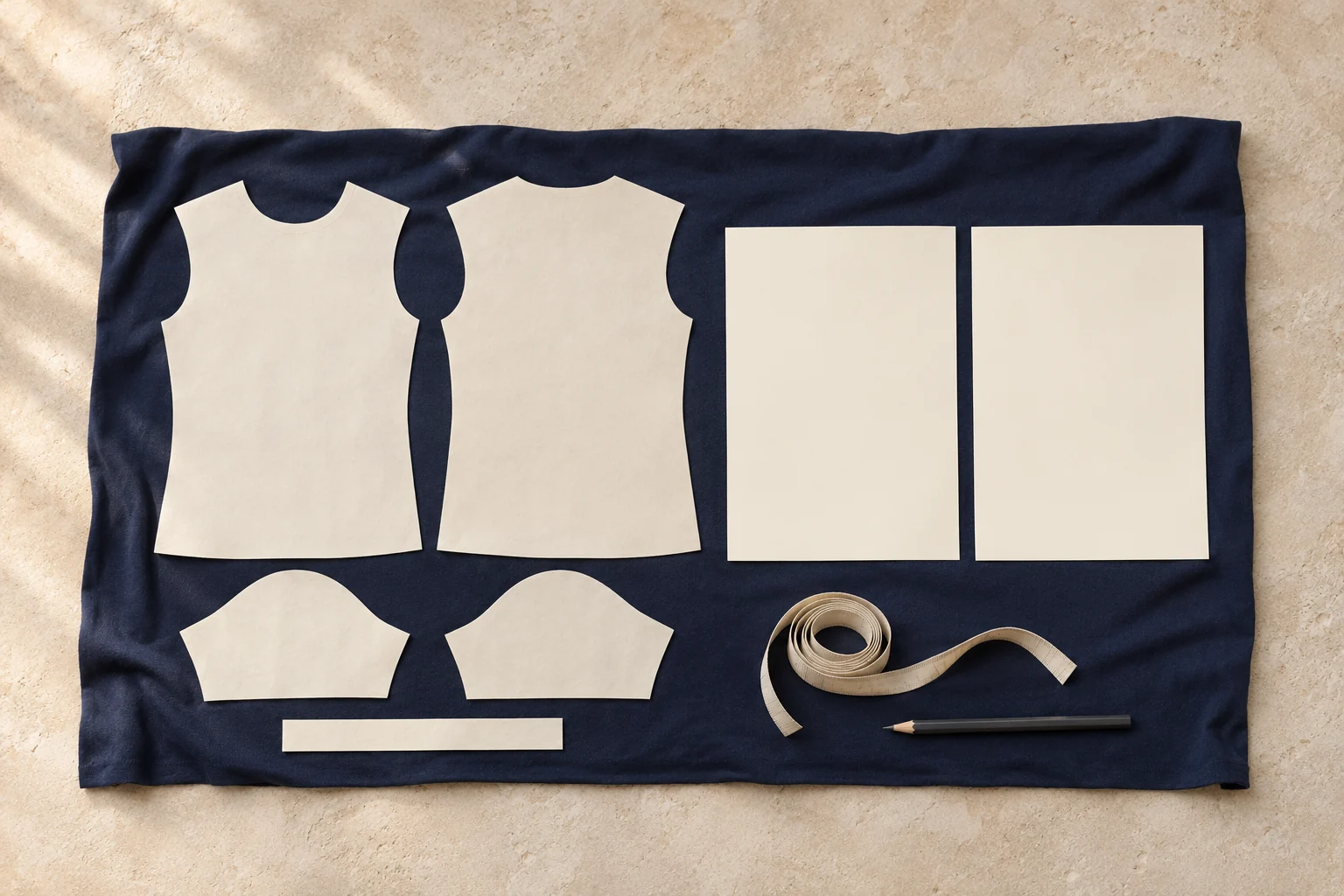
Freeze the garment that the quotation describes
Give the review one style reference, one colour and one named fabric component. Attach the tech pack and pattern revision that the suppliers were asked to cost. If the pattern remains under development, say so and name the current costing revision. Calling it a costing reference prevents a quotation from quietly becoming an approval of fit, construction or material.
A short-sleeve riding tee makes the point clearly. A revised body length or sleeve shape belongs to a different pattern basis even when the product name, colour and supplier stay the same. Ask whether the usage estimate follows the attached revision. If the supplier used its own development block, record that difference and request a response against the agreed reference before treating the figures as matched.
Keep body fabric, neck binding or rib, and any separate panel identifiable. A total without component boundaries can conceal different inclusions. The buyer does not need to reconstruct the supplier’s cutting work; the buyer needs to know which garment pieces and materials its quotation covers. Keep the current attachment with the quotation rather than relying on a filename mentioned in an earlier conversation.
Use the sampling checklist to assemble the specification reference before requesting the quotation.
Ask which width the supplier actually used
Put the stated width, its unit and the supplier’s description in separate fields. Does the number identify the nominal width on the fabric offer, the width entered for the marker, or a width the provider considers available for cutting? Do not replace these answers with the single label “fabric width”. A number copied correctly can still describe the wrong basis for this comparison.
For this record, ask the provider to explain what it means by usable or cuttable width, including any excluded edge areas. Ask whether the quoted consumption was prepared using that same width. The explanation must come from the actual quotation and material records. A roll photograph or a nominal-width label cannot establish the width used in a supplier’s calculation, and there is no standard edge deduction to insert here.
If one response reports nominal width and the other reports cuttable width, flag the mismatch. Request both estimates against the agreed width basis, or retain each as a separate, clearly qualified offer. Do not silently change the width in a spreadsheet while leaving the reported consumption unchanged. The provider must confirm the consequences of any revised basis.
Keep the width clarification attached to the relevant fabric article and quotation revision. A statement about a different fabric, colour or earlier offer does not close this row.
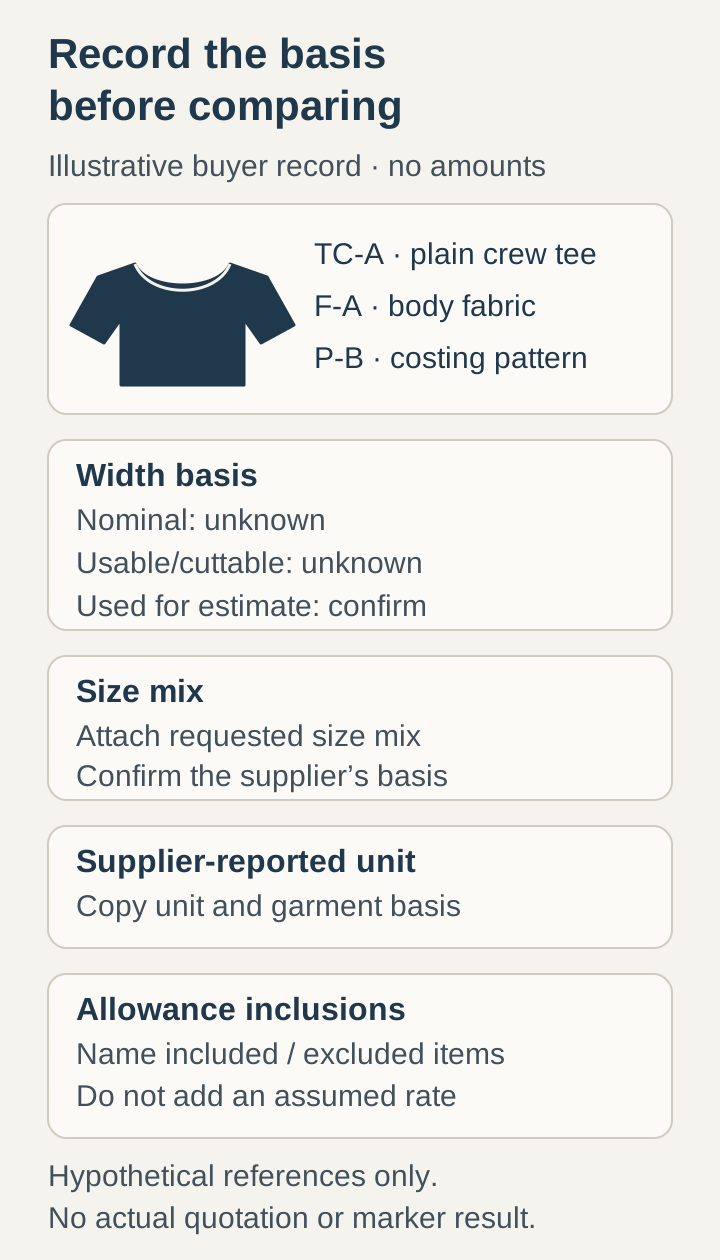
Keep the requested size mix attached to the estimate
Send the same requested size allocation to each supplier and ask which allocation supports its response. An estimate for a reference size and an estimate covering the requested range are different submissions. Neither becomes representative merely because the garment specification contains a full size chart. Request an explicit basis instead of assuming the supplier used every size listed.
Gerber’s Marker Wizard documentation illustrates why these fields deserve separate entries: the user selects models, specifies quantities for individual sizes and sets fabric width. The documentation supports treating those as distinct inputs. It does not tell this buyer which size mix or width a particular supplier used, nor does it validate that supplier’s estimate.
Record the order quantity and size allocation version that accompanied the request. If the commercial team later changes the assortment, send a revised brief and ask whether the usage and quotation need updating. Do not carry an estimate from the earlier mix into the new comparison without acknowledgement. This is a check on the consumption basis, rather than a new decision about how many styles or colours the range should contain.
Keep the supplier’s unit visible
Copy the supplier-reported consumption and unit exactly as submitted. Then ask what the denominator means: one garment, a stated group of garments, one marker or another identified basis. If it is a grouped record, request the provider’s explanation of the garment quantities and material components it represents. An unexplained number should remain an open question, even if its unit looks familiar.
A length-based body-fabric estimate and a weight-based estimate cannot be made comparable just by changing a column heading. Ask for a common reporting basis or a documented explanation from the provider. Do not infer a mass-to-length conversion from a photograph, an unconfirmed fabric weight or a general online calculator.
Keep the fabric price unit alongside the usage unit and confirm that both refer to the same material offer. Where a supplier gives only an assembled garment price, request clarification if fabric consumption is part of the buying decision. Do not reverse-engineer a consumption result by subtracting guessed labour or trim costs from that price.
Separate the stated usage from included allowances
Ask each supplier to name the allowances included in its reported figure and identify those excluded or still provisional. For any stated cutting waste, end loss, material preparation or shrinkage assumption, request its scope and supporting reference. A combined “wastage” entry needs explanation: it does not tell the buyer whether two suppliers have included the same things.
Do not add a generic percentage to make an incomplete response look complete. Equally, do not add an allowance again when the supplier says it is already included. Keep the supplier’s original figure, the inclusion statement and any revised figure together, so a later reader can see what changed and who confirmed the change.
If the material order quantity includes a reserve or another commercial provision, record that separately from the stated consumption basis. Ask how the provider connects the two records. This article does not prescribe how much reserve to buy, how to compensate a pattern for dimensional change, or how to plan extra cut quantities. Those decisions need their own agreed information and owner.
A useful response can state that an allowance is not yet determined. Leave the affected comparison provisional and request the missing evidence or confirmation. An explicit open item is more useful than a precise-looking total built from assumptions that neither party has accepted.
Read a marker figure within its own boundary
A marker screenshot can help identify the basis behind an estimate, but ask for the marker reference, revision, width, represented sizes and quantities, and the status of the record. A proposed target and a stored layout are not interchangeable. A cropped image showing only a percentage leaves the buyer unable to connect that figure to the quoted garment.
Gerber’s Marker Work Area help describes optional target length or target utilisation and relates utilisation to the arrangement of pieces within the marker area. That is a bounded software concept. The documented target does not establish an achieved production outcome, and the percentage alone does not supply total purchased-cloth yield or a supplier’s allowance basis.
Use the supporting record to clarify the quotation, not to announce a saving. If the supplier reports a change, ask for the old and new bases and its explanation of the revised consumption. Do not attribute the difference to improved layout, a fabric change or reduced waste unless the relevant evidence actually establishes that cause.
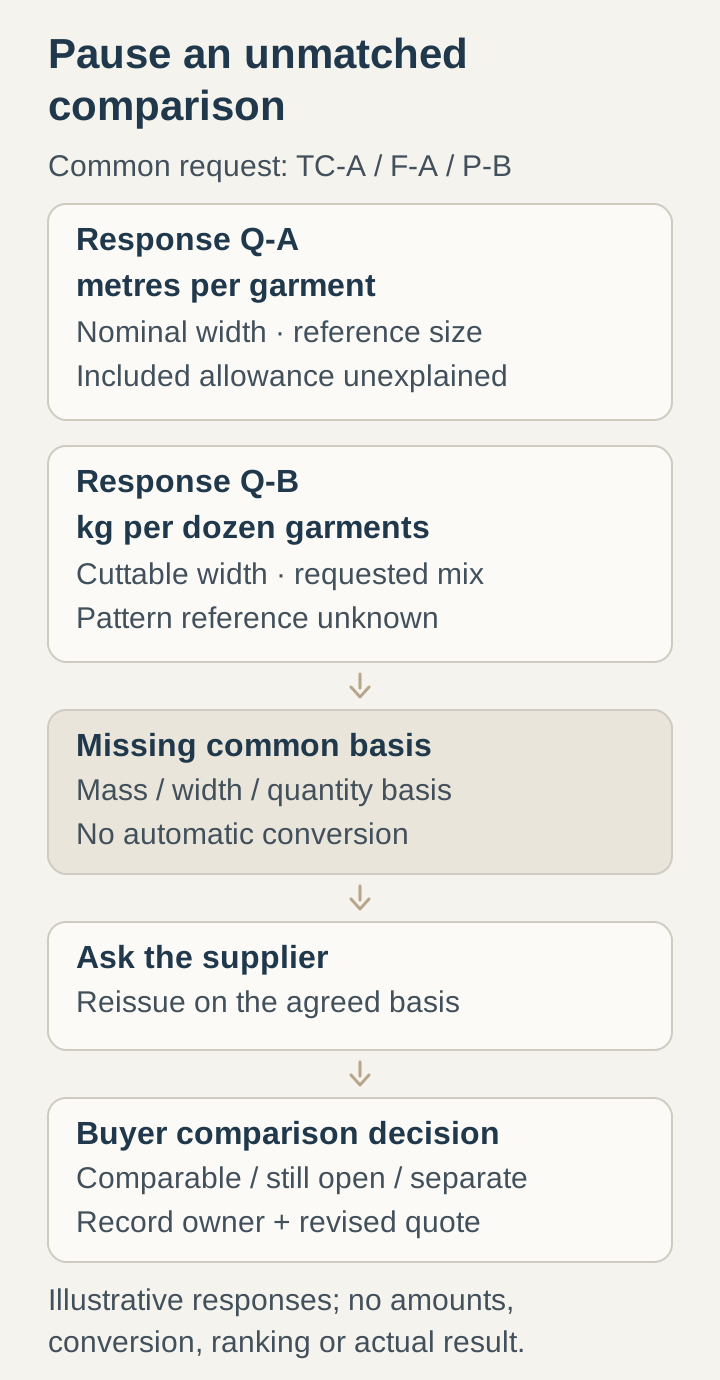
Hypothetical TC-A review: pause the comparison
Consider a hypothetical navy short-sleeve riding tee, TC-A, with body fabric F-A and costing pattern P-B. These identifiers and responses are invented solely to show a purchasing decision; no actual quotation, quantity, marker or consumption result is reported. The buyer sends both suppliers the same specification and requested size allocation.
Response Q-A names TC-A and reports body-fabric usage in metres per garment. Its width field says nominal width, and its size basis refers to a reference size. It says an allowance is included but does not explain which allowance. Response Q-B reports kilograms per dozen garments, describes its width as cuttable, and cites the requested size allocation. Its pattern attachment is not identified.
Neither response can yet serve as a matched fabric-consumption comparison. Q-A needs clarification of width, size mix and inclusions. Q-B needs the controlled pattern reference and an agreed reporting basis. There is no need to invent amounts or rank the suppliers to reach this decision: the records already show why comparing their usage figures would be premature.
The buyer returns a common brief identifying TC-A, F-A, P-B and the requested allocation. Both suppliers are asked to state their actual width basis, report usage on the agreed unit and garment basis, list inclusions and identify supporting records. The comparison remains on hold until the responses resolve those fields. If a supplier offers an alternative fabric or construction, it receives a separate option reference rather than being placed in the matched column.
Copy this blank consumption-comparison brief
Create one record per supplier response, linked by a common request reference. Leave unanswered entries blank and mark them for clarification. The fields below are a buyer’s working brief, not a certification form or a substitute for the supplier’s own technical records.
- Common request: style / colour / material component / tech-pack revision / costing-pattern revision / attachment reference: ____
- Requested order basis: quantity reference / size-allocation version / date sent to supplier: ____
- Supplier response: supplier / quotation reference / revision / date / person confirming the basis: ____
- Width: reported value and unit / provider’s width description / actual width used for the estimate / supporting record: ____
- Reported usage: value / unit / per-garment or grouped basis / represented sizes and quantities / component coverage: ____
- Inclusions: named allowances already included / exclusions / provisional assumptions / supporting references: ____
- Commercial basis: relevant fabric offer / price unit / scope of the quoted fabric line / separately stated provisions: ____
- Decision: comparable on the agreed basis / clarification needed / separate alternative; owner / requested revision / next review date: ____
Attach each clarification to its original response. When a revised quotation arrives, retain the superseded copy and record the replaced fields. This keeps a lower usage figure caused by changed scope from being mistaken for a like-for-like improvement.
Make the next request specific
Send questions against the open rows rather than asking the supplier to “check consumption” again. For example: confirm which width was used, identify the attached pattern revision, or reissue the estimate for the requested size allocation. Name the required response and its reference. This gives the supplier a clear correction task and gives the buyer something concrete to review.
Once the stated bases align, record that the consumption lines are comparable for this quotation review. That decision does not approve the garment sample, material performance, production yield or shipment. It also does not settle the whole supplier-selection decision. Keep other commercial differences visible in the wider quotation review instead of folding them into the fabric-consumption row.
If an input changes, reopen only the affected basis and request the corresponding revision. The useful output is a traceable comparison with known inclusions and open conditions, not a number detached from its garment. Keep that record with the development brief so the next person can understand what was compared without reconstructing the conversation.
Gerber’s official help separates marker inputs and distinguishes target length and utilisation within the marker work area. These software descriptions do not establish a purchased-cloth yield, a universal allowance or an achieved saving. The comparison brief and TC-A example below are editorial purchasing aids, not a Gerber procedure, a REINFORM calculation service or evidence of an actual order. No numerical production formula is supplied.
Bring the garment and material brief
Share the style reference, current specification, intended material and open quotation questions when discussing an OEM/ODM development project. Project-specific scope and sample arrangements need confirmation.
Discuss a garment development brief