 REINFORM
Agree what the TOP review will control
Define the milestone while there is still time to respond to it. Identify the style, colour, sizes and production run it will cover; who selects the garment; when it is taken; who reviews it; and which activity needs the resulting instruction. Depending on the order, that activity might be continuing an affected operation, processing the remaining balance or a separately defined shipment decision. Put the response arrangements into the production schedule rather than assuming a parcel sent to the buyer will pause anything automatically.
Buyer procedures show why those details cannot be assumed. J.Crew’s April 2023 manual distinguishes PP approval from a production-line TOP submission; its stated default does not require headquarters TOP approval before shipment unless specifically communicated for the style. DXL’s August 2022 process instead describes TOP review after PP approval and makes TOP approval a shipment condition. These are dated examples from particular buyers. Agree the rule for your order rather than combining them into a universal industry requirement.
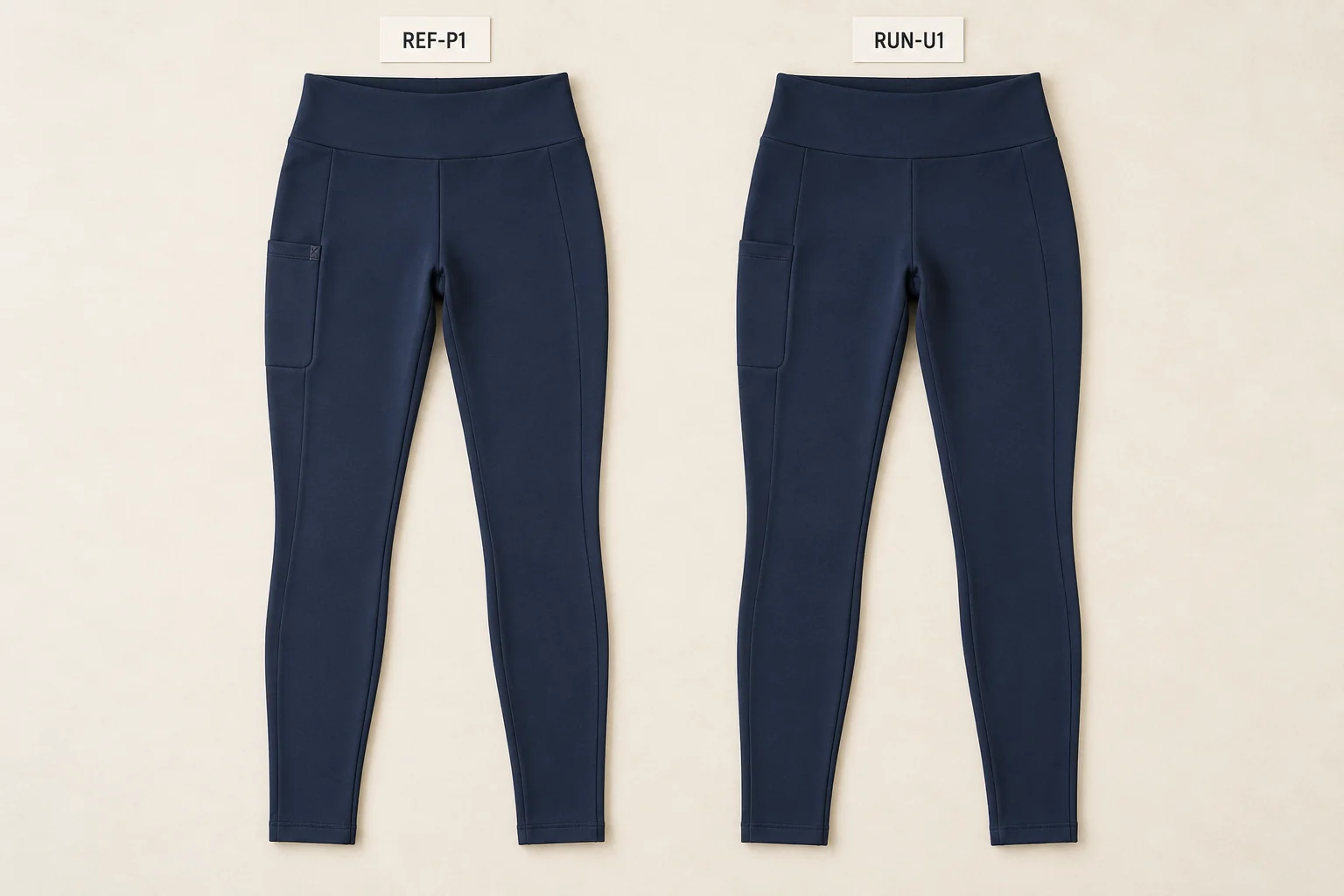
For the hypothetical tights, call the retained approved PP/reference REF-P1. Its matching specification identifies the small reinforcement at the upper phone-pocket corner nearest the front leg panel. Call the submitted unit RUN-U1. The buyer and manufacturer have agreed to compare early bulk output before continuing the affected pocket operation. That limited purpose does not itself authorise shipment, and it does not imply that every PP is made in a sample room. PP preparation varies; here its role is the controlled reference.
Follow RUN-U1 back to the actual bulk work
First establish why RUN-U1 represents production. Ask for the order and style reference, colour and size, production facility and line or work centre, extraction date, operation stage and the person who selected it. Connect those details to the manufacturer’s existing bundle or work record. A tag reading “TOP sample” is a description, not the whole evidence trail. The identifying record should let another colleague locate the relevant work without relying on the person who packed the sample.
Record what had happened to the unit before it was submitted. Was it taken after pocket attachment, after final finishing, or from goods already packed? Was any correction or extra finishing applied after extraction? In this example, the buyer asks for a completed unit from the named early run, retaining its original state. If the supplier adds the missing reinforcement before dispatch, the buyer loses evidence of the submitted discrepancy unless the original condition and intervention are recorded separately.
A garment sewn specifically to reproduce the approved pocket may be useful for development, but it cannot show that the bulk line followed that construction. Equally, one authentic production unit does not necessarily represent every colour, size, shift or work centre. Agree the submission coverage for the order and disclose its limits. If the supplier cannot establish RUN-U1’s origin, leave the production comparison unresolved and request a traceable unit; do not treat an unverified substitute as a successful line check.
Prepare and freeze the approved garment reference before this production-stage comparison.
Describe the pocket difference before judging its consequences
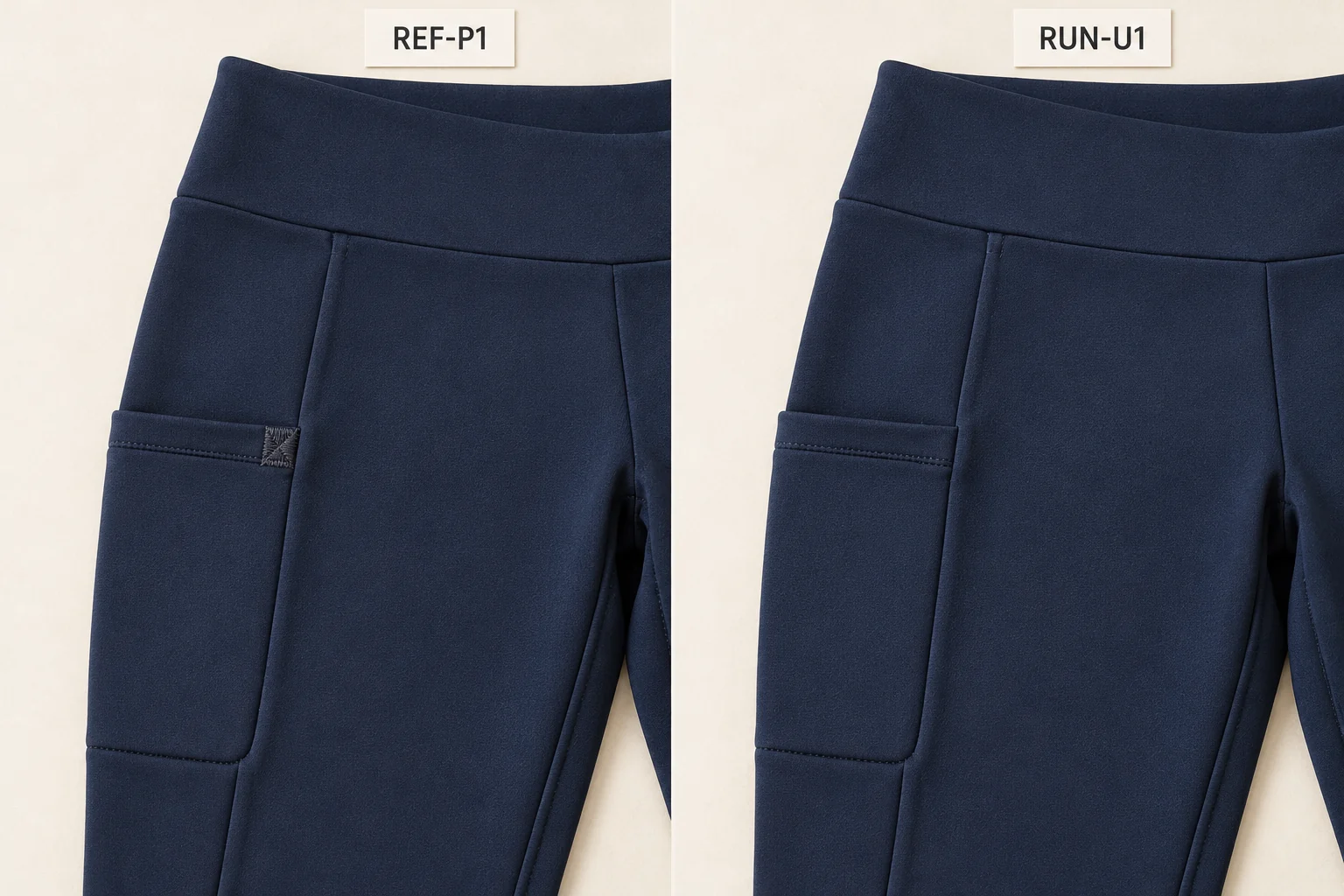
Place REF-P1 and RUN-U1 in the same relaxed viewing position. Identify the wearer’s right-thigh pocket and photograph its upper corner nearest the front panel. REF-P1 has a compact area of reinforced stitching at that corner; RUN-U1 shows the ordinary pocket seam without that reinforcement. The comparison images illustrate this difference only. They are not a stitch-class specification, a measured pocket-position result or a force test.
Write the finding as an observable mismatch: “Specified corner reinforcement visible on REF-P1 is absent at the corresponding location on RUN-U1.” Link it to the approved construction callout and the unit photographs. Avoid a broader statement such as “the pocket is weak” unless appropriate evidence supports it. An omitted specified operation requires a decision even when the pocket looks tidy; the photograph alone cannot establish strength, durability or performance with a loaded phone.
Check whether the difference is confined to that operation. Confirm the pocket construction and reference revision with the supplier, and record any other observed change separately. Do not infer that position is correct merely because the two images look similar; use the existing approved measurement method if placement needs checking. Nor should the team quietly remove the reinforcement from the specification to make RUN-U1 appear compliant. The original reference and finding remain part of the record while correction or a proposed concession is considered.
Separate completed garments, WIP and the unstarted balance
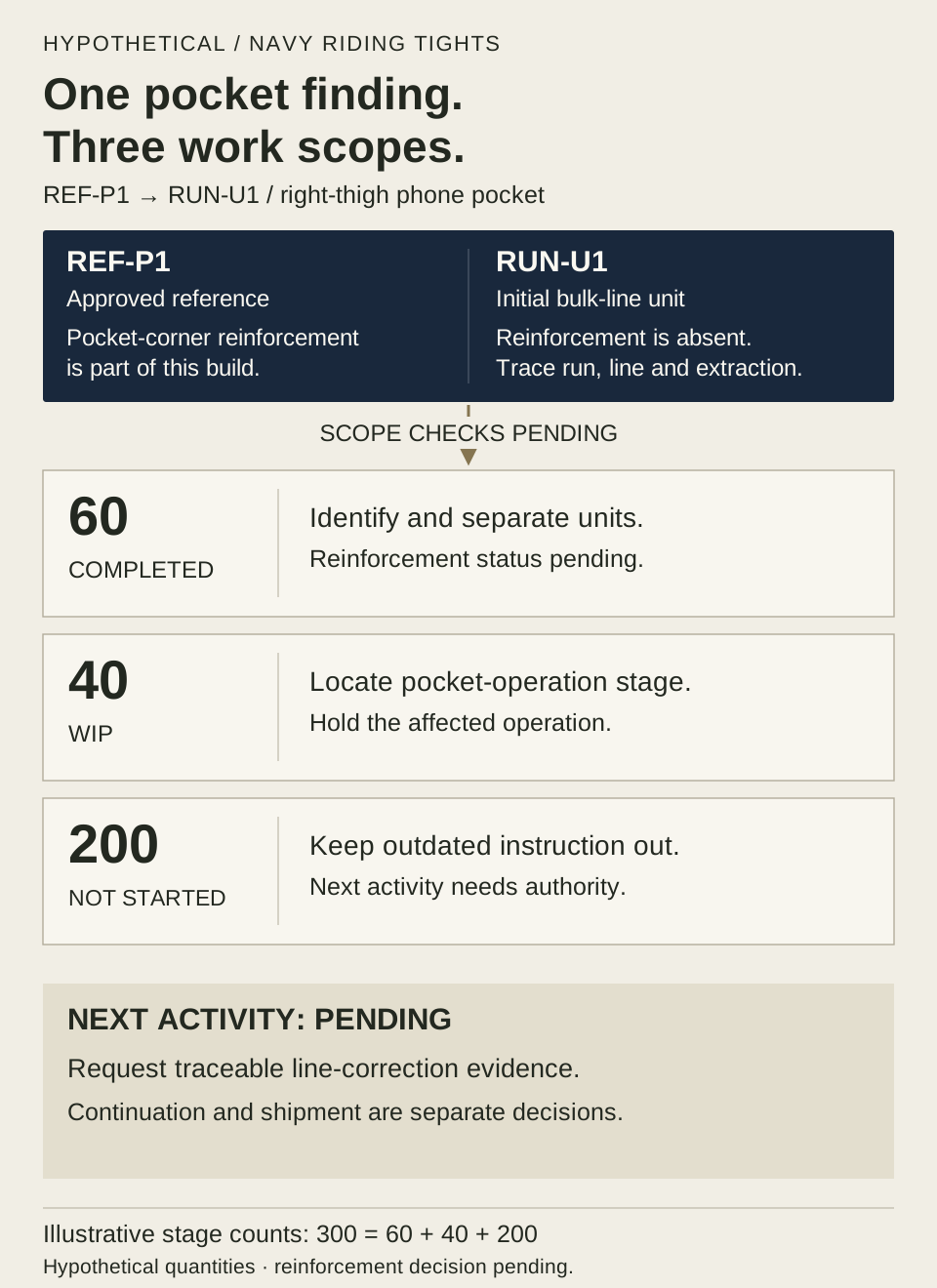
The finding becomes actionable when it is connected to work that can still be identified. Suppose this hypothetical order is 300 pieces of one style in one colour. At the review point, 60 garments are complete, 40 are cut and in work in progress, and 200 have not started. The stage quantities reconcile: 60 + 40 + 200 = 300. RUN-U1 is one of the 60 completed garments, not an additional piece. These are illustrative stage counts, not a prescribed TOP timing, sampling percentage or shipment total.
For the 60 completed garments, request identification and segregation pending an agreed check for the specified reinforcement. Do not assume all 60 share the omission because RUN-U1 does. Ask which bundles passed the relevant operation, what records exist and how affected units will be distinguished from units checked against the reference. Keep retained evidence and any garments removed for review visible in that accounting. “All checked” needs an identifiable scope and findings.
For the 40 WIP units, establish which have already passed pocket attachment and which have not. The next instruction depends on that distinction. A unit without the operation completed may follow the corrected instruction later; one that has passed it may require a separate correction route. For the 200 unstarted units, prevent the superseded operation instruction from being issued. The buyer can authorise unaffected activities separately if appropriate; an ambiguous message saying “hold production” does not explain which work must stop or what may continue.
In the example, the provisional instruction is to hold the affected pocket operation and the disposition of potentially affected completed garments while the scope is checked. It does not declare that all 300 units are defective or grant permission to ship the 60 finished pieces. Record the supplier’s stage update with a time and owner, because WIP can move while comments are being exchanged. Reconcile any changed quantities before a later continuation instruction.
Request a line correction, not just a tidier sample
Ask the manufacturer to explain where the approved reinforcement was lost from the production route. The relevant issue might be an omitted operation, an outdated construction instruction or a mismatch between the approved reference and the line’s working example. These are questions to investigate, not conclusions that can be drawn from one photograph. The response should identify the instruction being changed, the affected operation and the person responsible for applying it.
Have the supplier propose how the reinforcement will be added to the relevant WIP and completed garments, with the revised sequence shown on the actual construction. A repair route that suits an unfinished pocket may not suit a fully assembled tight. Ask whether the proposal could introduce visible needle marks, bulk, distortion or another issue, and which existing approvals need a further check. Do not prescribe a thread, needle, tension setting or extra rows merely because they look stronger.
The follow-up evidence must distinguish a corrected demonstration from the bulk action. A hand-finished garment can help review the proposed appearance, but it does not show that the production instruction has changed or that previously completed units were addressed. Request a traceable submission from the named bulk work after the revised operation is in use, retaining the link to RUN-U1 and the original finding. Keep the evidence for treatment of earlier units separate from evidence supporting continuation of the remaining work.
Keep a compact record and leave lot release separate
A useful TOP comparison file can be brief if its joins are clear. For this example, another reviewer should be able to follow REF-P1 to RUN-U1, see the missing pocket reinforcement, locate the relevant work and identify the current instruction. Keep these fields together:
- Approved reference and matching specification revision; garment, colour, size and the pocket-corner callout.
- RUN-U1 provenance: order/run, line or work centre, extraction date/stage, selector and any intervention after extraction.
- Original finding and matched photographs, kept distinct from a proposed explanation or a later corrected unit.
- Identified completed, WIP and unstarted scope, current quantities, check findings and segregation or hold references.
- Correction proposal, line instruction revision, follow-up submission provenance and treatment of earlier units.
- Authorised next activity, limits, conditions, decision owner and the separate status of shipment release.
Do not turn that record into a lot-inspection certificate. TOP units are submitted for an agreed early-production comparison; they are not automatically a randomly selected acceptance sample. A satisfactory follow-up can support the named next activity while later production still requires the agreed controls. It does not establish continued conformity of everything made afterwards, replace final inspection or reconcile the cartons prepared for dispatch.
Keep lot sampling, defect criteria and later release responsibilities in the AQL inspection brief.
When discussing an OEM/ODM order, send the approved construction reference and the production-stage question together. For the hypothetical tights, the decision remains concrete: which pocket operation may continue, which earlier garments still need action, and what evidence closes those actions? That is more useful than a general TOP approval detached from the units and work it is meant to control.
The cited J.Crew 2023 and DXL 2022 supplier documents are historical, buyer-specific examples of distinct PP and TOP stages. Their requirements differ, including the effect of TOP review on shipment. They support agreeing a production-origin comparison and the authority for the next activity; they do not establish a universal sample count, timing, tolerance or shipment gate, or a REINFORM protocol. The worked garment, identifiers and quantities in this article are hypothetical.
Define the production comparison in your garment brief
Share the approved garment reference, the operation you need to compare and the intended production-stage decision. Project-specific sample and review arrangements can then be discussed.
Discuss an OEM/ODM garment brief