 REINFORM

Begin with the event, not a shipment inspection
A broken needle incident starts with a reported event during a production operation. That is different from discovering a defect in a random sample of finished garments. The incident question concerns a physical component that may have broken, the pieces that can be accounted for and the work that passed through a relevant operation. A shipment inspection asks whether a defined lot meets agreed criteria under an inspection plan. The two decisions may connect later, but an ordinary AQL result cannot tell a team where an unaccounted fragment went.
Fashion Capital’s policy for The Factory describes reporting, recording recovered pieces, isolating potentially affected garments and escalating unresolved cases. This operator example establishes a real garment-production question; it is neither a universal procedure nor evidence of another factory’s controls.
Build an incident identity from records that exist
An event record is only useful when it can be connected to production. Ask the responsible team to identify the date and approximate time as recorded, the operator or responsible reporter, the machine or work station, the operation, and the order, style or bundle identifiers available at that point. Record the needle type or machine information only where the site already tracks it. The purpose is not to demand a particular form; it is to make clear which source records support the account and which fields are absent.
Keep the original description separate from later conclusions. A note such as “needle broke while sewing left pocket on style X” is an event description; “all goods from the shift are contaminated” is a scope conclusion that still needs evidence. If the operator, machine number or bundle tag is unknown, mark it unknown rather than filling the gap with a likely answer. A later reconstruction should say who supplied each detail, when it was added and whether another record corroborates it.
Where a factory maintains needle issue, replacement or maintenance records, the buyer can ask which entry relates to the event and how the entry is linked to the actual sewing operation. A buyer may also need the production traveller, bundle movement record, line assignment or packing record. These are possible evidence sources, not records that every factory necessarily keeps. Ask for the records available under the order and applicable buyer procedure; do not represent an illustrative record field as a mandatory global standard.
The event identity should survive handovers. A reference used by production, quality and warehouse staff lets the same incident be followed as garments move. If the factory’s internal reference differs from the buyer’s order number, preserve both and document their relationship. This prevents a later email about “the needle issue” from being confused with a different machine, style or date.
Reconcile the physical fragments carefully
A piece count is not a conclusion unless the responsible person knows what they are comparing. Ask how the broken item was identified, which parts were recovered, where they were secured and whether a record links those pieces to the event. If the site has an approved comparison method or retained replacement-needle reference, the responsible staff can explain it. The buyer should not ask an untrained person to handle sharp fragments or improvise a reconstruction outside the factory’s controlled safety procedure.
In The Factory’s example, the responsible person connects the pieces and signed record. Use that limited context to ask about custody under the actual site procedure; do not copy its roles or form.
The reconciliation should distinguish three states: pieces physically accounted for, pieces believed to be accounted for on a documented comparison, and pieces still missing or uncertain. Do not convert “we found something metallic” into “the needle is complete” unless the relevant responsible person can explain the basis. Likewise, do not quietly change a missing-piece status to resolved because a detector did not alarm or because a sampled garment looked normal. Those observations answer different questions.
Define the affected work from traceable boundaries
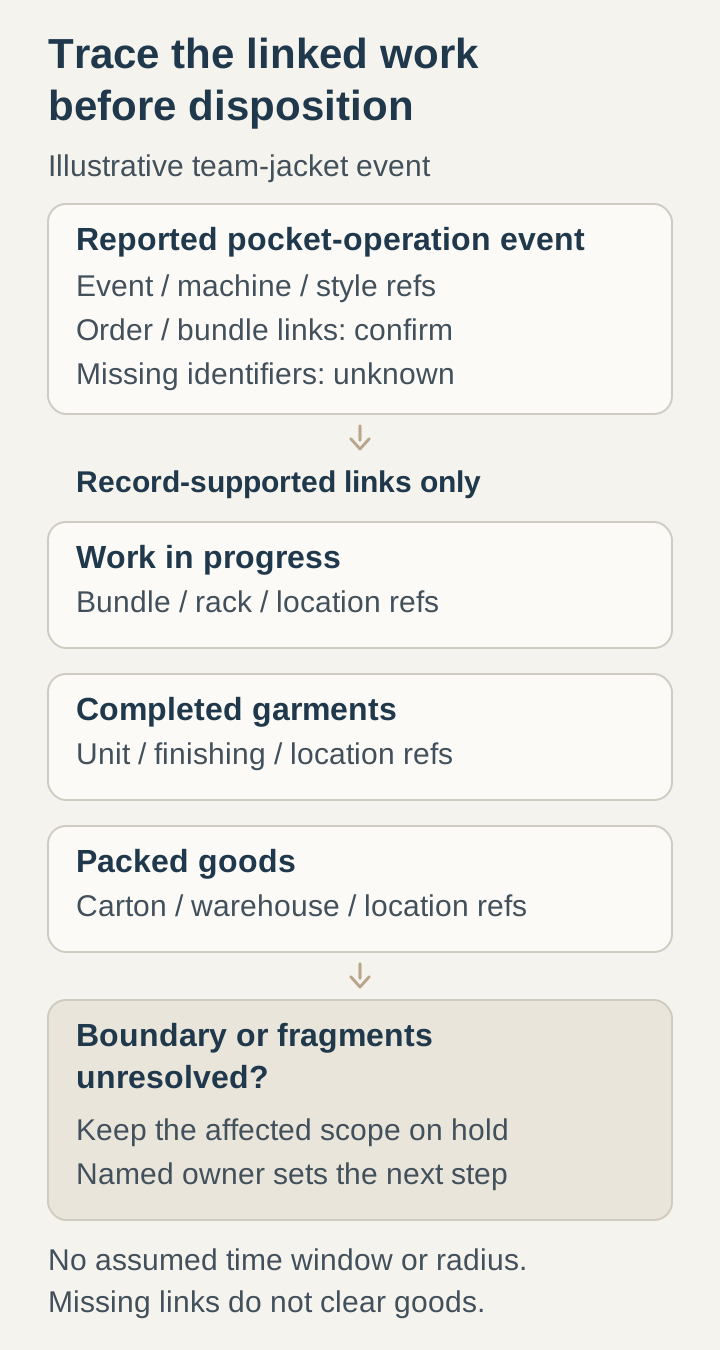
The scope question is not automatically “everything made that day” or “only the bundle on the machine”. It is: what work could reasonably be connected to this event under the records and buyer protocol available? Start with the reported operation and the identifiers that can be verified. Then follow their movement into work in progress, completed garments and packed cartons. Record the known boundary and its evidence, rather than selecting a convenient number of minutes, bundles or units.
A last verified intact state can be helpful if a site genuinely recorded one. It might be supported by a controlled needle change record, inspection entry or another traceable event, but the source and meaning must be clear. This article does not establish a universal “last known good” rule or say that the closest earlier entry is enough. If there is no reliable pre-event record, say so. The missing record may mean the affected scope cannot yet be narrowed; it must not be replaced by an assumed look-back window.
Follow the bundle or unit identifiers across operations. A garment may have left the sewing machine but remain in an identifiable WIP rack; another may have passed finishing, and a third may already sit in a carton. Ask whether those stages are linked to the same order and operation record. If the connection breaks, capture where it breaks and which quantities or locations are consequently uncertain. A total order quantity alone does not show which units were exposed to the event.
The applicable scope should be recorded as a reasoned decision with its owner. It may include a bounded set of identified bundles, completed units or cartons, but those boundaries must come from the project’s evidence and competent review. If records conflict—for example, the machine log identifies one bundle while a movement sheet shows a later bundle on the same operation—keep both accounts visible until resolved. Do not delete the wider possibility simply because it complicates the release plan.
Use a hypothetical order to test the trace
Consider a hypothetical team-jacket order with two sewing lines. A report identifies a needle break at one station during a pocket operation. The event note names a style and machine, but the bundle ticket is missing. The production sheet shows several bundles at that station during the shift; a warehouse record shows that some finished units from the style have already been packed. These details are invented only to illustrate the reasoning and do not describe a REINFORM order, customer or incident.
A useful reconstruction would first link the event note to the machine and style, then ask which bundle records can be independently matched to the operation and time. It would list the work still at the line, work moved to the next operation, finished units and cartons that remain connected to the same evidence. If one bundle cannot be identified, the file should say which evidence is missing and who is deciding whether a wider set needs to remain on hold. It should not silently assign that bundle to whichever side of the boundary makes dispatch easier.
The output is a scope statement with reasons: identified items, uncertain items, record references, current locations, containment status and the person responsible for the next decision. If records cannot connect a group of finished garments to the event, that uncertainty is part of the decision—not proof that the group was unaffected. Conversely, a group demonstrably outside the relevant operation may be treated differently only when the authorised reviewer accepts the supporting trace.
Assess the proposed examination against the garment
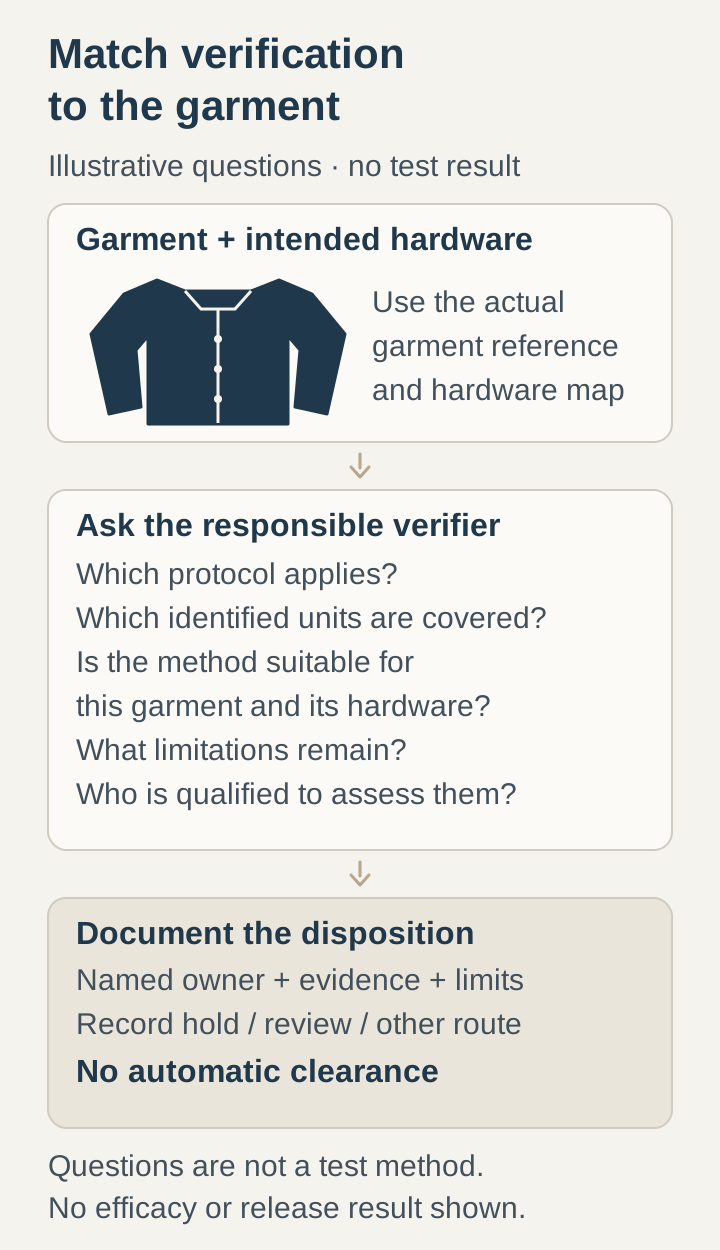
After identifying the work, ask what examination or other verification is proposed, who considers it suitable and what its limitations are. A riding garment may intentionally contain metal components such as zips, snaps, hooks or other trims. The garment’s construction, the suspected fragment and the equipment or method all matter to the assessment. A generic statement that a garment “passed detection” is not enough to understand what was examined, what could interfere, or which units the result covers.
The Factory qualifies handheld detection as appropriate within its system. An earlier Findel manual links a broken-needle record to the purchase order, machine, date and responsible signatures, and separates incomplete recovery from the bulk order. Findel’s document is a historical buyer example, not a current universal requirement or equipment-suitability guide.
Ask the verifier to connect the method to the incident and garment: which identified units were checked, how the check was documented, what intentional hardware was present, and what limitations remain. Do not prescribe sensitivity, pass counts, a scanning pattern or a technical recipe unless the responsible qualified party and applicable customer protocol establish it. If the proposed method cannot distinguish intended hardware from a possible fragment, that is a question to resolve before relying on its result.
Keep the fragment record and the examination record separate but linked. Finding and accounting for the physical pieces is not the same as screening a group of garments; screening is not the same as authorising dispatch. A test result must identify its scope and method, while a disposition decision must identify the person or organisation authorised to make it.
Keep unresolved work controlled until an authorised decision
If a fragment or the affected boundary remains unresolved, show that uncertainty and the work still under review. The Factory’s published example keeps suspect garments unreleased while pieces remain unaccounted for and escalates to its manager. Identify the protocol and competent authority governing the actual order.
For a buyer, the practical next step is to ask who owns the investigation, who controls the affected goods and who can authorise any rework, further examination, continued hold or release. The answer may involve the factory’s quality lead, the buyer’s technical contact, an approved inspection provider or another qualified reviewer. Do not ask a salesperson or a general AQL inspector to make a safety determination outside their role.
No single disposition follows automatically from a missing fragment. Depending on the applicable protocol and competent assessment, the decision could require further identification work, a suitable examination, rework or another agreed route. This guide does not prescribe destruction, repair or a release test. Record the decision, its authoriser, the evidence considered, any limits and how the affected units remained identified while the decision was pending.
Close the event record without turning it into an AQL result
A compact incident file should let a later reviewer reconstruct the logic without relying on memory. Link the event identifier, source records, fragment status, affected-work boundary, locations and quantities, actions taken, examination evidence and final authorised disposition. Keep unresolved assumptions visible. This is a recommended buyer-side record structure, not a copied form or an assertion that every factory has the same documentation system.
AQL inspection still has a separate job: it applies an agreed sampling plan and defect criteria to a defined lot. It can inform a wider quality decision when its scope and results are relevant, but it does not establish that a particular needle fragment was recovered or determine which bundles crossed a breakage event. Do not use a passing sample as a substitute for physical accounting or a reasoned incident scope.
When the event is closed, preserve the original report and the subsequent decisions together. If the investigation remains open, label it open rather than replacing the event with a clean-looking final inspection summary. The useful outcome is not a universal checklist: it is a traceable explanation of what was reported, which garments may be connected, how uncertainty was handled and who made the decision under the applicable order requirements.
For an OEM garment brief, identify the garment, intended markets, order context and quality question. Agree any project-specific controls, verification scope and responsible parties when the requirements are reviewed.
The Factory policy is one operator’s published practice; the displayed page date does not independently date its underlying procedure. Findel’s public file carries a 2022 copyright and differing filename/cover version labels, so its record fields are used only as a historical buyer example. Neither source supplies a universal affected-work boundary, operating recipe, equipment-suitability decision or REINFORM service claim. The scenario and diagrams are hypothetical purchasing aids, not an actual incident or verification result.
Bring the quality question into the garment brief
Share the garment reference, order context and the quality decision you need to resolve. Project scope and responsibilities require separate review.
Discuss an OEM garment brief